
























Google HOPE Model: The Future of Continual Learning AI and Lifelong Adaptation
Google introduces the HOPE model — a breakthrough in continual learning AI that allows systems to evolve like humans without forgetting old data. Discover how this innovation reshapes the future of adaptive intelligence, personalization, and India’s AI ecosystem.
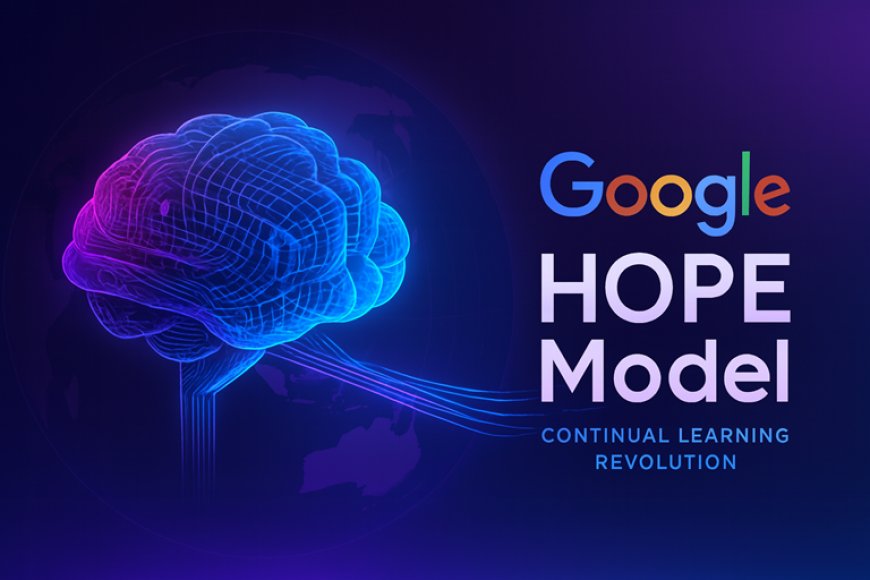
Google’s HOPE Model Marks a Major Leap in Continual Learning AI — A New Era for Smarter, Adaptive Machines
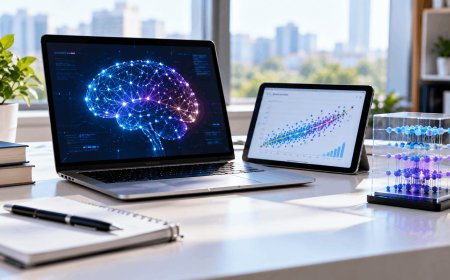
In a landmark development for artificial intelligence, Google has unveiled its latest breakthrough: the HOPE model — an advanced AI system built on the principles of continual learning. This innovation allows AI systems to keep learning from new information without forgetting previously acquired knowledge — a problem known as “catastrophic forgetting.”
The Google HOPE model continual learning initiative represents a massive step toward AI systems that mimic human-like adaptability. Instead of retraining from scratch, HOPE can retain, refine, and expand its understanding as it encounters new data — revolutionizing how AI evolves across industries.
🔍 What Is the Google HOPE Model?
HOPE — short for Hierarchical Online Progressive Enhancement — is Google’s new framework designed to solve one of AI’s oldest problems: the inability to learn continuously without overwriting past knowledge. Traditional machine learning models are static; they perform well within a defined dataset but struggle when introduced to new information.
In contrast, the HOPE model introduces a nested continual learning structure. It layers knowledge hierarchically, allowing AI to understand context over time — much like how the human brain builds memory and reasoning. Google researchers describe this as the foundation for “lifelong learning AI.”
🌐 How Continual Learning Differs from Traditional AI
- Static vs Dynamic Training: Traditional AI models are trained once and deployed. Continual learning models like HOPE keep evolving with each new dataset.
- Memory Preservation: Instead of “forgetting” previous tasks, HOPE preserves earlier knowledge while integrating new patterns efficiently.
- Contextual Reasoning: The system can adapt its responses based on cumulative understanding — improving reasoning, recall, and decision-making accuracy.
- Energy Efficiency: Continual models require less computational retraining, saving both cost and energy in long-term AI deployment.
🧠 Inside Google’s HOPE Architecture
The HOPE architecture relies on three core mechanisms:
- Hierarchical Knowledge Layers: Information is stored in layers, ensuring that new learning doesn’t overwrite old data.
- Progressive Fine-Tuning: The model refines only relevant portions of its neural network when new data is added.
- Error-Corrective Memory: HOPE includes a self-monitoring layer that detects inconsistencies and re-balances stored knowledge automatically.
In simple terms, this means the model can evolve across tasks — such as switching from image recognition to natural language reasoning — without performance loss. For Google, this could become the foundation for AI agents that never stop learning.
🌏 Why It Matters — AI That Learns Like Humans
One of the biggest limitations in AI today is its static nature. While models like Gemini and GPT-4o are incredibly advanced, they rely on fixed datasets. Once deployed, they don’t “learn” in real time. HOPE changes that equation entirely.
By enabling ongoing, self-regulated learning, continual learning models could power next-generation applications like:
- Personalized virtual assistants that evolve with individual users over years.
- Healthcare AI that updates automatically with new medical data and discoveries.
- Autonomous systems that adapt continuously to new driving or environmental conditions.
- AI education platforms that tailor lessons dynamically for each learner.
“Google’s HOPE model could mark the moment when artificial intelligence moves from being trained once to learning for life — the holy grail of machine intelligence.”
🇮🇳 Impact on India’s AI Ecosystem
For India’s fast-growing AI research community and tech startups, Google’s HOPE model offers both opportunity and inspiration. Continual learning aligns perfectly with the country’s push toward scalable, context-aware systems — especially in healthcare, fintech, and education.
- Healthcare: Indian health startups can deploy continual AI to update diagnosis models automatically with new patient data or regional disease trends.
- Agritech: AI systems in agriculture could refine crop predictions over time using localized, seasonal data.
- Education: Edtech platforms like BYJU’S or Unacademy could integrate continual learning AI to adapt study materials in real time to student progress.
- Government Initiatives: Under India’s National AI Mission, continual AI could play a key role in sustainable data governance and adaptive automation.
🧩 Comparison: HOPE vs Traditional AI Models
| Feature | Traditional AI | Google HOPE Model |
|---|---|---|
| Learning Process | Single training phase | Continuous incremental learning |
| Data Handling | Static datasets only | Dynamic, streaming datasets |
| Performance Over Time | Degrades with new data | Improves adaptively |
| Energy Efficiency | High retraining cost | Optimized incremental updates |
💬 Expert Viewpoint
AI researchers view continual learning as one of the most critical frontiers in artificial intelligence. By addressing catastrophic forgetting, the HOPE model positions Google at the forefront of adaptive AI — potentially shaping the next decade of machine learning.
According to early reports from Google Research, the HOPE framework integrates seamlessly with existing LLM architectures. This means future versions of Gemini, Android AI features, or Google Workspace tools could quietly benefit from continual learning without users even realizing it.
⚙️ Real-World Use Cases of Continual Learning
- Smart Search Systems: Search engines that refine relevance dynamically based on ongoing user behaviour.
- Cybersecurity: Threat detection models that evolve daily to counter new attack vectors.
- Finance: Credit-scoring models that learn from evolving market data in real time.
❓ FAQ – Google HOPE Model and Continual Learning
A: HOPE (Hierarchical Online Progressive Enhancement) is Google’s new continual learning model that allows AI to learn and adapt continuously without forgetting past data.
Q: How is continual learning different from normal machine learning?
A: Unlike traditional models that require retraining with each dataset, continual learning enables progressive updates while preserving earlier knowledge.
Q: Will HOPE replace Gemini or Bard?
A: No — it complements them. HOPE may serve as an underlying learning framework to make models like Gemini more adaptive and context-aware.
Q: How will this affect developers in India?
A: Developers could integrate continual learning APIs into applications, enabling smarter automation in sectors like healthcare, finance, and edtech.
Q: When will the HOPE model become publicly available?
A: Google hasn’t confirmed an exact date but hinted at testing phases in 2026 within its AI ecosystem and research collaborations.
📚 Sources & Further Reading
- Indian Express – Google’s Big Step in Continual Learning
- Google AI Blog – Continual Learning Research
- DeepMind Publications – Adaptive AI Models
Sneak peek: As Google pushes the boundaries of AI with its HOPE model, continual learning may soon define the standard for next-generation AI — smarter, sustainable, and ever-evolving.
What's Your Reaction?
 Like
0
Like
0
 Dislike
0
Dislike
0
 Love
0
Love
0
 Funny
0
Funny
0
 Angry
0
Angry
0
 Sad
0
Sad
0
 Wow
0
Wow
0