










































Airbus Orders Emergency Software Fix for 6,000 A320 Jets After Solar-Radiation Risk Incident
Airbus has grounded and recalled nearly 6,000 A320-family aircraft worldwide after discovering that solar radiation can corrupt ELAC flight-control software. Here’s what caused the issue, how airlines are responding, and what passengers should expect during the global update.
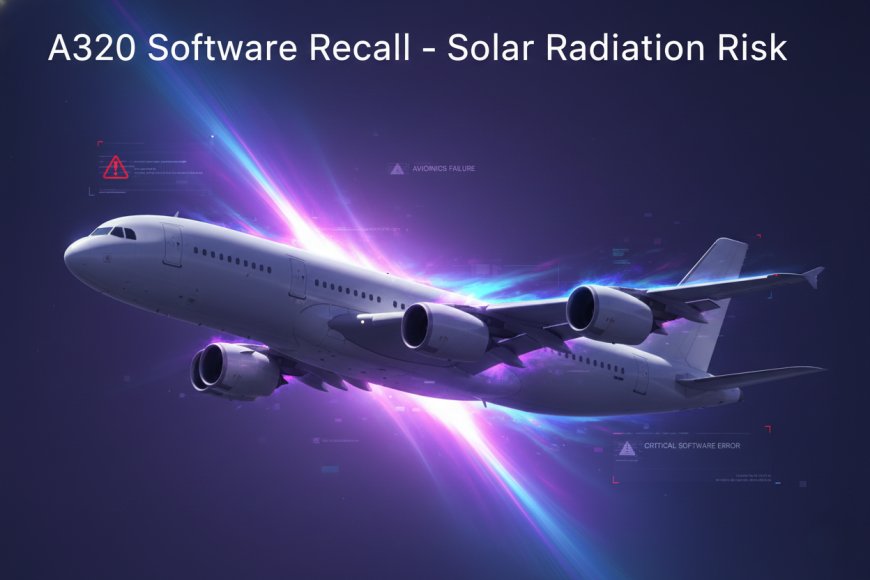
Airbus Orders Software Fix for 6,000 A320 Jets After Solar-Radiation Risk — Global Travel Impact (Nov 2025)
Airbus has issued an urgent worldwide recall of thousands of its A320-family aircraft after discovering that intense solar radiation can corrupt data critical to flight control systems. The directive affects roughly 6,000 jets — nearly half the global A320 fleet — which must receive a software update before they can carry passengers again. The move, triggered by a serious mid-air incident involving a JetBlue Airways A320 on October 30, 2025, has already caused widespread flight delays and cancellations across airlines globally.
🛑 What Happened: The JetBlue Trigger & Solar Radiation Risk
The recall was prompted by a JetBlue flight from Cancun to Newark that experienced an unexpected drop in altitude mid-air. Investigators tied the incident to a malfunction in the aircraft’s flight-control computer — the Elevator Aileron Computer (ELAC) — which appears to have been corrupted by “intense solar radiation.” According to Airbus, radiation-induced data corruption (so-called “bit flips”) in ELAC software caused erroneous pitch commands, leading to the loss of altitude.
In response, Airbus issued an “Alert Operators Transmission” (AOT), and civil regulators — including the European Union Aviation Safety Agency (EASA) and Federal Aviation Administration (FAA) — ordered an emergency software fix or rollback before affected jets can fly passengers again.
🔧 What the Fix Involves — Software Rollback (and Hardware for Some)
For most of the affected fleet, the required action is a software rollback — reverting ELAC to a previous, safer version. Airbus estimates that this update takes approximately two hours per aircraft.
However, older jets — about 900–1,000 of them — also need hardware replacement of ELAC units, since the radiation-vulnerable hardware combined with the newer software is deemed unsafe. These replacements require more extensive maintenance and will take longer.
🌍 Global Impact: Groundings, Flight Disruptions & Holiday Chaos
The timing of the recall — just ahead of a busy travel holiday season — has caused major disruption worldwide. Airlines globally, including in Europe, the U.S., Asia and India, have grounded affected jets, leading to cancellations and delays.
- Most airlines are rushing to install the fix during overnight layovers or maintenance windows.
- Some carriers with older aircraft requiring hardware swaps expect longer ground-time and more significant schedule impact.
- Passengers on affected airlines are advised to check status before traveling.
In India, for example, regulators and airlines are performing updates on hundreds of A320 jets.
⚠️ Why Solar Radiation Poses a Risk — How Space Weather Affects Aircraft
Solar flares and coronal mass ejections from the Sun can send charged particles toward Earth. At high altitudes — where commercial jets cruise — these particles can induce bit-flips in sensitive avionics electronics, potentially corrupting software or data stored in memory.
While modern aircraft rely on redundancy and multiple fail-safes, the combination of a vulnerable ELAC software version and solar radiation exposure was found to be enough to trigger a rare but serious malfunction. Airbus warns the issue remains “very unlikely” during normal conditions, but says the risk is serious enough to mandate the recall.
📑 What Airlines & Regulators Are Doing — Safety Over Convenience
Airlines are working around the clock to comply. According to statements, maintenance crews are updating software and performing required checks, even if it means flight delays or cancellations.
Regulatory agencies — including EASA and FAA — have issued Emergency Airworthiness Directives making the fix mandatory before passenger flights resume. Airlines operating registered jets must confirm installation or return the aircraft to maintenance-only status.
Airbus apologized for the inconvenience and emphasized that safety is the company’s top priority. Meanwhile, airline operators are coordinating fleet rotations and customer communications to minimize disruption.
✈️ What It Means for Passengers — Safety First, But Expect Delays
For travellers, the immediate risk appears to be inconvenience, not danger. Airlines and Airbus have acted proactively, isolating the issue before any further incidents occurred. That said, passengers should:
- Check flight status before heading to the airport
- Allow extra time for possible delays or cancellations
- Be prepared for rebooking in case their aircraft is grounded
In the long run, these precautionary measures could substantially improve flight safety — but the short-term disruption is real, especially because the recall affects a large portion of the global Airbus A320 fleet.
🔮 What’s Next — Investigation, Monitoring, and Long-Term Safeguards
Airbus, together with avionics manufacturers and regulatory agencies, is conducting a deep investigation to fully map the vulnerability. Key steps include:
- Reviewing and hardening all ELAC systems globally
- Introducing radiation-hardened software and hardware safeguards
- Updating certification standards to include space-weather resilience
- Improved space-weather forecasting and integration with flight-planning systems
The incident may lead to broader changes in how aircraft electronics are certified — especially for long-term reliability in high-altitude, high-radiation environments.
📚 Sources & Further Reading
- TechCrunch – Airbus orders software fix to thousands of planes
- Reuters – Airbus major A320 recall after flight-control incident
- Aviation Week – EASA orders immediate A320 flight control software changes
- The Federal – Explainer: why Airbus issued safety alert for A320s
Sneak peek: The recall shows how even decades-old aircraft lines like the A320 must now contend with modern challenges — including cosmic-scale phenomena like solar radiation — reminding airlines and regulators that vigilance remains crucial in an ever-changing aerospace environment.
What's Your Reaction?
 Like
0
Like
0
 Dislike
0
Dislike
0
 Love
0
Love
0
 Funny
0
Funny
0
 Angry
0
Angry
0
 Sad
0
Sad
0
 Wow
0
Wow
0