









































Vector Databases Explained: The Hidden Engine Behind AI Chatbots
What vector databases are, how they power AI chatbots via RAG, and what Indian developers should weigh on data compliance.
Ask a chatbot about your company's leave policy or a product manual that was never part of its training data, and a well-built one will still answer correctly, quoting the right paragraph. It isn't magic. Somewhere behind the scenes, a vector database found that paragraph in milliseconds and handed it to the AI model before it replied. If you've been hearing the term thrown around in AI product discussions and nodding along without quite knowing what it means, here's the plain-English version.
Why regular databases can't do this job
A normal database, the kind that runs your banking app or your food delivery order history, is built for exact matches. You ask for order ID 48213, it looks up that exact row and returns it. That works great when you know precisely what you're searching for.
But "which paragraph in this 200-page HR policy is relevant to my question about maternity leave" isn't an exact-match problem. The words in your question probably don't even appear in the document. You need something that understands meaning, not just spelling. That's the gap a vector database fills.
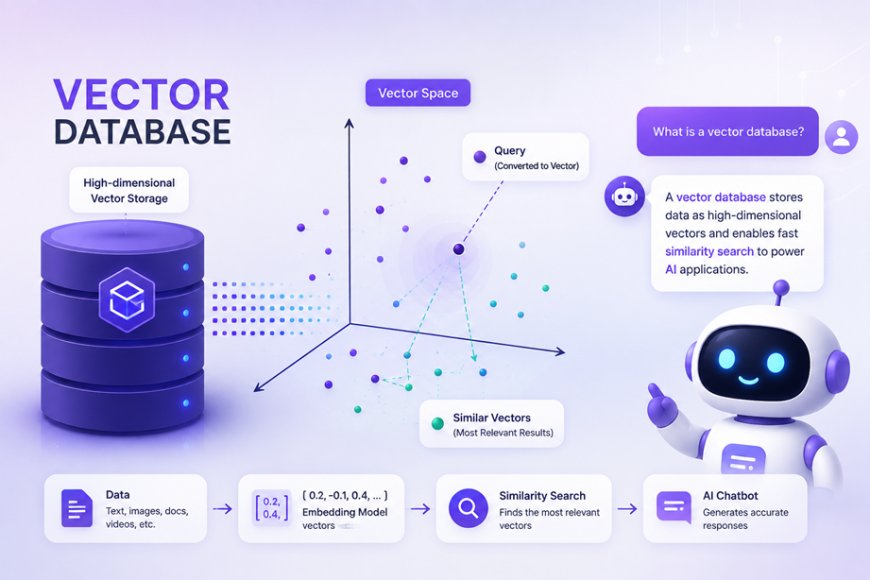
It does this using embeddings, a fancy word for a fairly simple idea: an AI model reads a piece of text (or an image, or audio) and converts it into a long list of numbers, sometimes hundreds or thousands of them. Text with similar meaning ends up with similar numbers, even if the actual words are completely different. "I want to quit my job" and "How do I resign" would land close together in this number-space, while "I want to quit my job" and "best biryani in Hyderabad" would land far apart.
How a search actually happens
Once everything, your documents, your product catalogue, your support tickets, has been converted into these number-lists (called vectors), a vector database's whole job is to answer one question fast: "given this new vector, which stored vectors are closest to it?" That's it. It's essentially a very efficient way of measuring distance between thousands or millions of points in a mathematical space, and returning the nearest ones.
This is the engine behind a technique called RAG, short for retrieval-augmented generation. Instead of expecting an AI model to know everything from training alone, RAG fetches the most relevant few paragraphs from your own data first, using a vector database, and feeds those to the model along with the question. The model then answers based on what it was just handed, not just what it memorized months ago.
A language model without retrieval is answering from memory. A language model with a vector database behind it is answering with the book open in front of it.
That distinction matters a lot in practice. It's why a well-built customer support bot can correctly quote your refund policy from last week, while a generic chatbot might confidently make one up.
What this means if you're building in India
This isn't just a Silicon Valley concern. Indian startups building AI customer support tools, internal knowledge bots for enterprises, or regional-language assistants are leaning on exactly this pattern, because training a custom model from scratch is expensive, but connecting an existing model to your own data through a vector database is not.
There's a compliance angle too, worth knowing if you handle Indian users' data. Under the DPDP Act (India's Digital Personal Data Protection law), and depending on the sector, RBI or MeitY guidance around data handling, a fintech or healthtech company piping customer PII through a fully-managed, foreign-hosted vector database needs to think carefully about where that data physically sits and how it's processed. This is one reason self-hosted, open-source options are gaining traction among Indian engineering teams that want more control over where their vectors live, rather than defaulting to a third-party managed service by habit.
The tools people actually use
You don't need to build this from scratch. A handful of options cover most use cases, and picking between them is really a question of scale and how much infrastructure you want to manage yourself, similar to the tradeoffs between the different cloud hosting models we've covered before.
- pgvector — an extension for Postgres. If your app already uses Postgres, this is the lowest-friction way to add vector search without adopting a whole new system.
- Chroma — lightweight and popular for smaller projects, prototypes, and hackathon builds.
- Weaviate and Milvus — open-source, built for larger scale, and both can be self-hosted, which matters for the data-residency reasons above.
- Pinecone — a fully managed, hosted service, easy to start with but worth checking its data-hosting regions before sending sensitive information through it.
For a solo developer or a small team testing an idea, pgvector or Chroma will get you a working prototype in an afternoon. It's only once you're pushing millions of vectors and need sub-50-millisecond lookups at scale that the dedicated systems start to earn their extra operational complexity.
Where this is heading
Vector databases aren't a passing trend tied to the current AI hype cycle. The underlying problem, finding the most relevant piece of information out of a large, messy pile, existed before large language models and will outlast whatever the next model architecture turns out to be. If you're building anything that needs an AI system to reason over your own data rather than generic internet knowledge, understanding this piece isn't optional background reading anymore. It's the part of the stack that decides whether your AI feature actually knows what it's talking about, or is just guessing convincingly.
What's Your Reaction?
 Like
1
Like
1
 Dislike
0
Dislike
0
 Love
0
Love
0
 Funny
0
Funny
0
 Angry
0
Angry
0
 Sad
0
Sad
0
 Wow
0
Wow
0