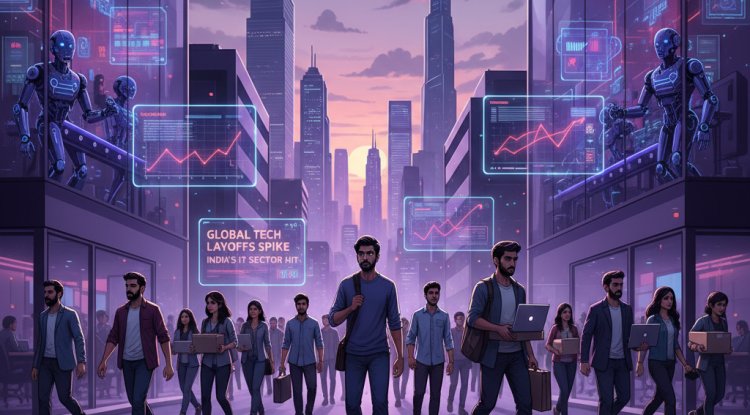











































Tech Layoffs Top 198,000 in 2026 While India's GCCs Keep Hiring
Global tech layoffs have hit nearly 200,000 in 2026, but India's Global Capability Centres are hiring at a record pace. Here's why.

Nearly 200,000 tech workers worldwide have lost their jobs so far in 2026 — and on the same week that number ticked past that mark, recruiters in Bengaluru and Hyderabad were still posting ads they couldn't fill fast enough.
The scoreboard so far this year
According to TrueUp's live layoffs tracker, 2026 has seen roughly 680 separate layoff announcements affecting more than 198,000 people, an average of about 650 a day. That's actually a touch lower than 2025's full-year toll of nearly 246,000, but the names doing the cutting are the same familiar giants, and the pace hasn't let up.
- Amazon has cut close to 17,000 roles this year, the single biggest contributor to the total.
- Meta has trimmed around 8,700 jobs.
- Microsoft has cut roughly 4,800, alongside smaller but notable rounds at eBay, Netflix and Electronic Arts.
These figures count announced reductions, not necessarily completed ones, and trackers disagree on exact totals depending on what they count as a "tech" layoff. But every tracker tells the same broad story: a profitable industry is still shedding people.
It's not a downturn, it's a rewiring
What makes this round of cuts different from the layoffs of 2022-23 is the stated reason. Back then, companies blamed over-hiring during the pandemic. This time, executives are increasingly candid that automation and AI tooling are doing work that used to need a team. Customer support, QA testing, parts of software engineering and swathes of middle management are being restructured around AI agents and copilots, not just cost discipline.
The companies doing the biggest layoffs are also the ones spending the most on AI infrastructure — the two numbers are not a coincidence.
That combination — record profits, record AI capital spending, and record layoffs — is why this wave feels less like a recession and more like a structural shift in what kinds of jobs a software company needs at all.
The India paradox: GCCs are hiring like never before
Here's the twist that rarely makes it into the global headlines: while headquarters in Seattle and Redmond shrink, the India arms of these same multinationals are growing. Global Capability Centres, or GCCs — basically in-house offshore units that global companies set up in India to run engineering, finance, analytics and increasingly entire product lines rather than just back-office work — are on track to add well over 500,000 jobs in India in 2026 alone, according to industry estimates. That's roughly three times the hiring pace of just five years ago.
A few things stand out in the hiring data:
- Nearly two out of every three new GCC roles now demand AI, data science or automation skills — the same skillset that's displacing jobs elsewhere.
- Technology, software and financial services together account for more than half of all GCC hiring.
- Bengaluru still leads, but Tier 2 cities are growing fastest as centres chase cheaper real estate and deeper talent pools.
In other words, the same AI wave wiping out headcount in the US is a reason multinationals are expanding their India footprint — it's cheaper to build and run AI-driven operations out of India than almost anywhere else, and the local talent pool is deep enough to staff it.
What it actually means if you're job-hunting in India
For Indian tech workers, this isn't an unambiguous win. GCC hiring is skewing hard toward AI, data engineering and automation roles, which means the traditional path of getting an entry-level coding job and learning on the job is narrowing. Pure "cost arbitrage" roles — the kind where a centre exists mainly to do the same work for less money — are shrinking as a share of total GCC jobs, while centres that own entire products or global mandates are growing. We covered a similar split last year in our look at how the 2025 layoff wave reshaped hiring in India, and the pattern has only sharpened since.
The practical takeaway: a computer science degree alone is no longer the moat it used to be. The GCCs and startups absorbing India's talent supply are explicitly hiring for applied AI skills — not necessarily building frontier models, but knowing how to deploy, fine-tune and operate them inside a real business. That's a very different bar than it was three years ago, and it's one that engineering colleges and bootcamps across the country are still catching up to.
What's Your Reaction?
 Like
0
 Dislike
0
 Love
0
 Funny
0
 Angry
0
 Sad
0
 Wow
0