




































Nvidia Halts H200 Chip Sales to China After Huang's Exit
Nvidia has stopped shipping its China-approved H200 AI chips, ending a hard-won export deal with ripple effects for India's own chip ambitions.

Nvidia just walked away from roughly $2.4 billion a quarter in revenue, and it did so almost quietly, buried inside an otherwise blockbuster earnings call.
What Nvidia actually said
On its November 17 earnings call, interim CEO Colette Kress told analysts that Nvidia has stopped shipping its licensed Hopper-generation data center chips — the category that includes the China-specific H200 — into the country. She was blunt about the accounting: the company's forward guidance, she said, "does not have any licenced Hopper data centre products included." In plain terms, Nvidia isn't just pausing shipments, it's telling investors not to expect China revenue from this chip line at all going forward.
That's a reversal of a deal that took months of diplomacy to put together. The H200 was a cut-down, export-control-compliant version of Nvidia's AI chip, negotiated between Jensen Huang and the Trump administration specifically so Nvidia could keep selling some hardware into China without breaching US national security rules. It was never a free-for-all: Washington capped what could go out, and Beijing had its own say in what came in.
Why the loophole closed from both sides
This wasn't a one-sided US decision. China had already started restricting H200 imports of its own accord, part of a broader push by Beijing to wean its AI industry off American hardware and build up domestic alternatives. Reuters has reported that roughly 600,000 H200 chips were sitting in Hong Kong warehouses, built and paid for, simply waiting on a shipment that was never going to clear. Around the same time, Washington tightened the rules further, barring advanced US chips from being used in foreign data centers that serve Chinese customers remotely — closing off a workaround some buyers had been using to access the compute indirectly.
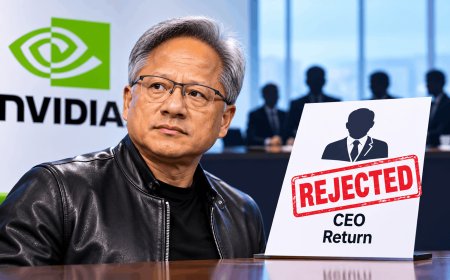
Add to that the leadership chaos at Nvidia itself. Jensen Huang, the man who personally brokered the China carve-out, resigned as CEO on November 11 following a board investigation, with CFO Kress stepping in as interim chief. Code24 covered the board's decision days later to reject Huang's return as CEO, so the China exit lands on a company that is, for now, running without the one executive who had the political relationships to keep the deal alive.
"Does not have any licenced Hopper data centre products included." — Colette Kress, Nvidia interim CEO, on the company's forward revenue guidance
What this means if you're not Nvidia or Beijing
For Indian readers, this isn't just a US-China story happening somewhere else. India doesn't fall under the specific export carve-out that applied to China, but it sits inside the same tiered US export-control system that decides which countries get which grade of Nvidia silicon, on what timeline, and at what price. Every time Washington recalibrates its China policy, the ripple reaches the GPU allocation queues that Indian cloud providers, AI startups, and government compute programs like the IndiaAI Mission are standing in.
- Tighter China controls can free up more advanced chips for other markets — but they can also mean Nvidia prioritizes its biggest, most stable customers first, and India's cloud and startup demand is still smaller than that of the US "hyperscalers" — the handful of giant cloud companies like Microsoft, Amazon, and Google that buy GPUs by the hundreds of thousands.
- A leaderless, distracted Nvidia negotiating fewer carve-outs is one more argument for India's own semiconductor push, including the $13.5 billion India Semiconductor Mission 2.0 and Tata's domestic chip fabrication plans, both aimed at reducing exactly this kind of single-vendor, single-geopolitics dependency.
- Indian AI firms building on rented GPU capacity from global clouds should expect pricing and availability to stay volatile as long as Nvidia's China relationship keeps lurching between "managed exception" and "fully closed."
The uncomfortable part nobody's saying out loud
Nvidia didn't frame this as a strategic pivot. Kress gave no reason for the halt and wouldn't say whether it's permanent or just paused. That ambiguity is doing real work: it lets Nvidia keep selling what it can elsewhere without formally declaring the China market dead, while leaving the door open in case Washington, Beijing, or a future permanent CEO decides to reopen it.
What's actually changed is simpler than the policy noise suggests. The country that makes almost all of Nvidia's advanced AI chips is now, for the first time in years, not selling its newest ones to the world's second-largest economy — at the exact moment it doesn't have a confirmed CEO to manage the fallout. Whoever the board eventually appoints permanently inherits not just a product roadmap, but a geopolitical relationship that's currently running on autopilot.
What's Your Reaction?
 Like
0
 Dislike
0
 Love
0
 Funny
0
 Angry
0
 Sad
0
 Wow
0