






































Cradlewise Raises $12M to Take Its AI-Powered Crib Global
India-founded Cradlewise raised $12 million to grow its AI-sensing crib, made in Pune, into a global baby-sleep brand.
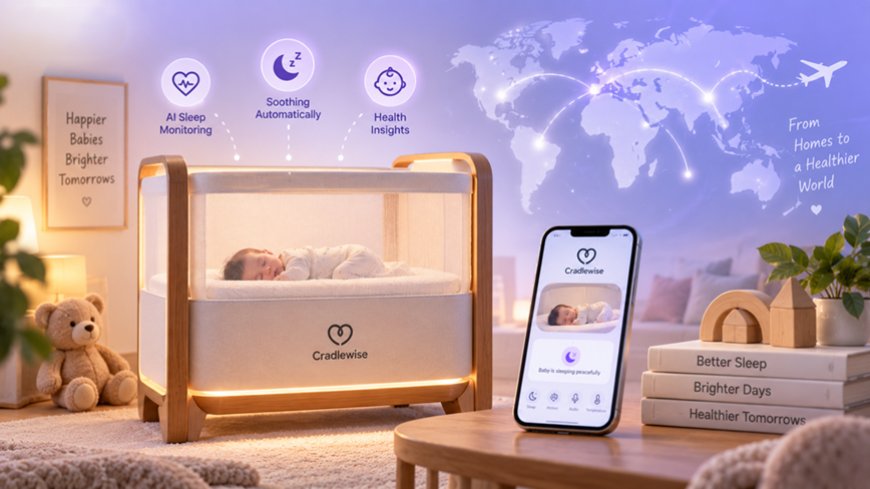
A crib that feels a baby stirring before the cry even starts, and gently rocks them back down without anyone getting out of bed — that's the product Cradlewise has spent seven years building, and investors just handed it another $12 million to take it further.
What the Crib Actually Does
Cradlewise isn't a wooden box with a motor bolted on. It's built around what the company calls a closed-loop system — plain English: sensors constantly feed data back into the crib's own software, which adjusts its behaviour in real time instead of running on a fixed timer. Contactless sensors (no wearable strapped to the baby, just cameras and motion/sound tracking built into the frame) watch movement, sound and sleep state, and the crib starts a gentle rocking or soothing routine the moment it detects early signs of waking, aiming to settle the baby before a full cry sets in. A companion app lets parents watch the sleep data and override or adjust the routine.
It's a genuinely hard engineering problem dressed up as a baby product: real-time signal processing, on-device inference, and enough reliability that sleep-deprived parents trust it to run unattended next to an infant all night.
The Round and Where the Money's Going
The $12 million Series A was led by 3one4 Capital and Prudent Investment Management, taking Cradlewise's total funding to $26 million since it was founded in 2019 by Radhika Patil and Bharath Patil, a couple who met as electronics classmates at the Indian Institute of Science. Earlier backers including Sean O'Sullivan Ventures, Footwork VC and Charles River Ventures also returned.
The company says the capital is earmarked for a few specific things:
- Expanding beyond direct online sales into retail and international partnership channels
- Building lower-priced entry points, since the current crib sits at a premium price that puts off a chunk of would-be buyers
- Developing software-led sleep routines and additional sleep hardware that extend past the crib itself, into toddlerhood rather than just the 0-24 month window
- Reusable sensing and electronics modules meant to shorten how long future products take to build
Co-founder and CTO Bharath Patil framed the bet in terms of restraint rather than more features:
"Cradlewise is about sensing, learning, and having an impact. We wish to create tech that does not shout out its presence but solves challenges in a way that we forget about them."
Built in Pune, Sold to the World
The part of this story worth an Indian reader's attention isn't just that two IISc graduates built a baby-tech company — it's where the crib is actually made. Cradlewise manufactures at a facility in Pune capable of producing, testing and packing thousands of units a month, and is using this round to scale that up while chasing a "global kids sleep brand" built out of India and the US at once. That's a rarer combination than it should be: most Indian D2C hardware brands either import and rebrand or manufacture cheap for the domestic market. Cradlewise is doing precision electronics manufacturing at home and selling the finished, premium-priced product into the US.
There's also a privacy angle Indian parents should sit with. A crib with cameras and always-on audio sensing is, functionally, an always-on data collection device pointed at an infant — movement, sound and sleep patterns, continuously logged. Under India's Digital Personal Data Protection (DPDP) Act, a child's data carries extra obligations: verifiable parental consent and no behavioural tracking or targeted advertising aimed at minors. Cradlewise sells mainly overseas today, but as Indian-made connected devices for babies and kids become more common, how that sensor data is stored, who can access it, and whether it ever gets used for anything beyond soothing a baby to sleep is exactly the kind of question the DPDP framework was written to force companies to answer upfront.
A Sleep-Deprived Market Worth Betting On
Funding for consumer hardware has generally been a harder sell than software in the current investment climate — hardware is capital-intensive, inventory-heavy and slow to iterate compared to shipping a software update. A $12 million round for a crib says investors think sleep tech for new parents is a category with real, recurring willingness to pay, not a novelty. Whether Cradlewise can bring its price down enough to go from a niche premium purchase to something closer to mainstream is now the real test — the last funding rarely funds the hard part.
What's Your Reaction?
 Like
0
Like
0
 Dislike
0
Dislike
0
 Love
0
Love
0
 Funny
0
Funny
0
 Angry
0
Angry
0
 Sad
0
Sad
0
 Wow
0
Wow
0