







































QNu Labs Raises ₹200 Crore for India's Quantum-Safe Encryption Push
QNu Labs raised ₹200 crore to scale quantum-safe encryption for India's banks, defence and digital infrastructure.
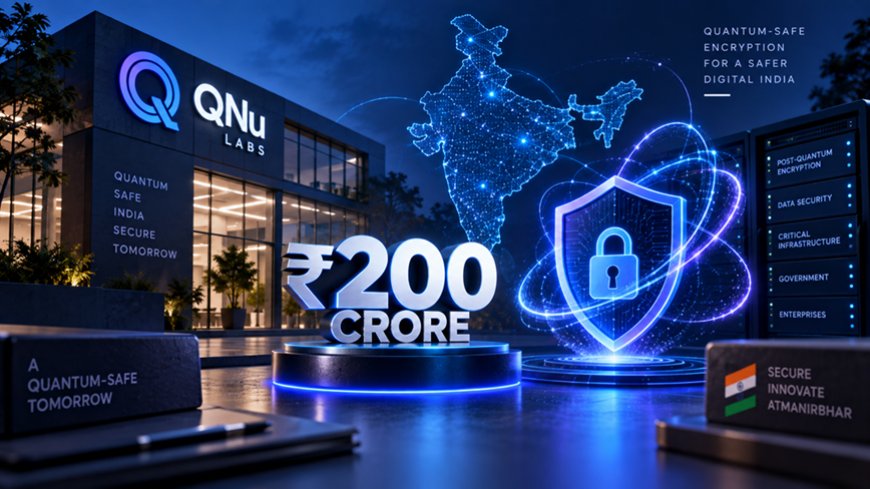
A ten-year-old Bengaluru company that spent years selling quantum cryptography to the Indian Army and a handful of banks just got the government's own quantum fund to write it a cheque. QNu Labs has raised ₹200 crore (about $25 million) in a Series A1 round led by the National Quantum Mission and Speciale Invest, taking its total funding to ₹375 crore.
What QNu Labs actually sells
QNu Labs doesn't build quantum computers. It builds the defence against them. The company, incubated at IIT Madras in 2016 and now based in Bengaluru, makes what's called quantum-safe cryptography — encryption designed to stay unbreakable even after quantum computers become powerful enough to crack the math that protects almost all of today's internet traffic, banking transactions, and government communications.
Its product line includes Quantum Key Distribution (QKD), which uses the physics of light particles rather than mathematical puzzles to generate encryption keys, so any attempt to intercept a key physically disturbs it and gives itself away. It also sells Post-Quantum Cryptography (PQC), newer math-based algorithms built specifically to resist quantum attacks, and Quantum Random Number Generation (QRNG), which produces genuinely random numbers for security systems instead of the semi-predictable ones ordinary computers generate.
Why this round matters now, not in five years
The threat isn't that someone will crack your bank's encryption tomorrow. It's a slower, quieter problem security researchers call "harvest now, decrypt later": adversaries and intelligence agencies are already siphoning off encrypted data today, betting that a sufficiently capable quantum computer within the next decade will let them unlock it retroactively. For anything that needs to stay secret for years — defence communications, health records, financial systems — that clock is already running, which is exactly why governments have started funding this category of company well before quantum computers are actually a mainstream threat.
That urgency shows in where QNu's technology already sits: protecting Indian Army and Navy networks, and increasingly reaching banks and public infrastructure operators. Part of the new capital will fund QNu's role in an RDI-approved project to build the technology backbone for India's Quantum Secure and Sensing Networks, alongside a push into quantum sensing and AI-linked security tools.
"This is a strong validation of our vision to make quantum-safe security the foundation of the digital world," said Sunil Gupta, co-founder and CEO of QNu Labs.
The India angle: sovereign crypto as infrastructure policy
This raise sits squarely inside India's National Quantum Mission, the government's ₹6,000-crore, eight-year program to build domestic quantum computing, communication, and sensing capability rather than depend on imported systems for something as sensitive as encryption. For Indian banks already navigating RBI's data-localisation and cybersecurity guidelines, and for any company handling personal data under the DPDP Act (India's data protection law), quantum-safe infrastructure isn't a distant research problem — it's the next compliance wave once regulators start asking what happens to today's encrypted customer data a decade from now. A homegrown vendor with defence-grade credentials gives Indian institutions an alternative to importing this technology from the US or China, which matters as much strategically as commercially.
- Total funding to date: ₹375 crore, following an earlier ₹60 crore Series A round
- New backers this round: Sony Innovation Fund, Gaja Capital, and Artha Ventures, alongside lead investors National Quantum Mission and Speciale Invest
- Team: roughly 160 engineers, physicists, and mathematicians
- Existing deployments: Indian Army and Navy networks, with expansion into banking and public infrastructure
What happens next
QNu Labs plans to use the money to scale sales both in India and internationally, while deepening R&D on quantum sensing. None of this makes quantum computers an immediate danger to your phone's banking app — that's still likely years away. But the interesting part of this story isn't the threat timeline, it's who's paying for the defence early: a state-backed quantum mission, private VCs, and a Japanese electronics giant's innovation fund, all betting that whoever controls quantum-safe infrastructure controls a very quiet, very consequential layer of the next decade's digital economy.
What's Your Reaction?
 Like
0
Like
0
 Dislike
0
Dislike
0
 Love
0
Love
0
 Funny
0
Funny
0
 Angry
0
Angry
0
 Sad
0
Sad
0
 Wow
0
Wow
0