





























SiMa.ai Raises $150M to Build AI Chips for Robots and Drones
Chipmaker SiMa.ai raised $150M at a $1.45B valuation to build AI silicon for robots and drones, with real engineering work happening in Bengaluru.
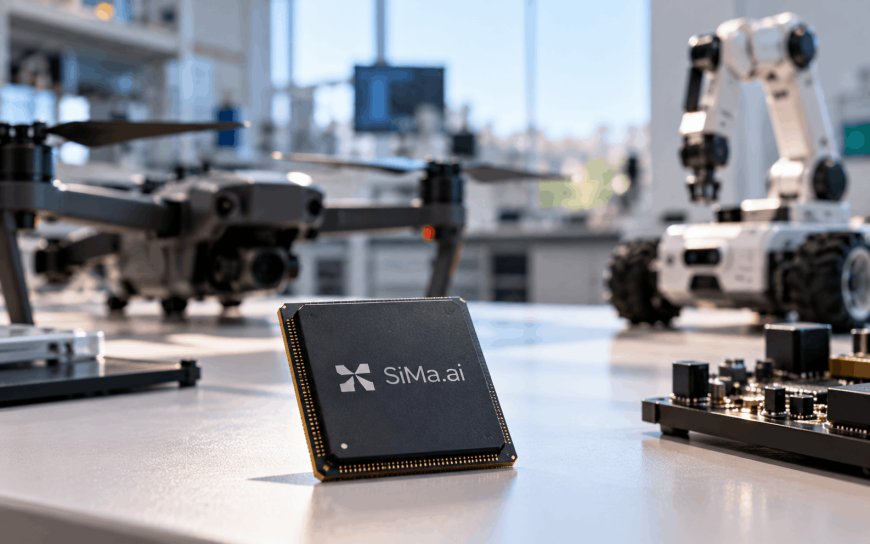
A chip startup most people outside the semiconductor world have never heard of just got valued at $1.45 billion — not for software, but for silicon meant to go inside machines that move: robots that walk, drones that fly themselves, and cars that brake before a human driver would.
The round, in plain numbers
SiMa.ai, a San Jose-headquartered chip company, has closed a $150 million Series C — the funding stage startups typically raise once a product is proven and they need serious capital to scale it — co-led by Fidelity Management & Research and Amplify, with Dell Technologies Capital, J.P. Morgan, Maverick Capital and even the State of Michigan's investment arm joining in. That brings the company's total funding to $500 million since it was founded. The money isn't going toward a product you'll see this year — it's funding a next-generation chip platform slated for the first half of 2028, built to deliver what the company calls "1,000 dense TOPS" of compute. TOPS stands for trillions of operations per second, the industry's shorthand for how fast a chip can crunch through AI calculations; 1,000 dense TOPS packed into a low-power chip is a serious jump from what's commercially available on edge devices today.
The target customers tell you where this is headed:
- Medium and high-end drones that need to process camera and sensor data without phoning home to a cloud server
- Humanoid robots, the category Tesla, Figure and a wave of Chinese manufacturers are racing to commercialize
- Advanced driver-assistance systems and AI-powered car cockpits
Why "physical AI" needs different chips
Most AI people interact with daily — a chatbot, a search summary, an image generator — runs in a data center somewhere, with effectively unlimited power and cooling on tap. A robot arm or a delivery drone doesn't have that luxury. It carries its own battery, generates its own heat, and often has to make a decision — stop, swerve, grip — in milliseconds, with no network connection to lean on. That's the premise behind "physical AI": intelligence that has to run entirely on the device, within a tight power budget, in real time.
Robots and drones don't get to borrow a data center's compute. The intelligence has to live on the machine itself, running off a battery, with no room to wait for a round-trip to the cloud.
It's a crowded field — Qualcomm, Hailo and Ambarella are all chasing the same low-power edge-AI market — which is part of why investors are willing to write large checks well ahead of SiMa.ai's next chip actually shipping.
The India connection that's easy to miss
Here's the part that matters to readers in India specifically: SiMa.ai isn't just a Silicon Valley name with an Indian-American founder at the top, though CEO Krishna Rangasayee — who spent years running Xilinx's multi-billion-dollar semiconductor business before starting SiMa.ai — fits that familiar pattern. The company has built out a full design center in Bengaluru, with engineering led locally by Gopal Hegde, Sudershan Vuruputoor and Amit Kumar Mitra, covering everything from hardware architecture to the software stack that runs on top of the chips.
That matters beyond one company's hiring page. India has spent the last few years trying to move from writing software for chips designed elsewhere to actually doing chip design work at home, through programs like the government's Design Linked Incentive scheme. A well-funded startup running real silicon architecture work out of Bengaluru — not just a support or testing function — is exactly the kind of high-skill engineering mandate that policy is trying to attract. It's also a signal for India's own drone and robotics startups, several of which currently import edge-AI modules from abroad because nothing built domestically hits the power-and-performance bar these machines need.
What to watch next
None of SiMa.ai's new hardware ships before 2028, so this round is a bet on where robotics and autonomous machines are headed, not a product announcement. But the amount of capital chasing physical AI chips right now — against a backdrop of humanoid robot demos multiplying every few months — suggests the companies that get the power-efficiency equation right early will have a real head start when the hardware actually needs to leave the lab.
What's Your Reaction?
 Like
0
Like
0
 Dislike
0
Dislike
0
 Love
0
Love
0
 Funny
0
Funny
0
 Angry
0
Angry
0
 Sad
0
Sad
0
 Wow
0
Wow
0