

























Nvidia's $13 Billion Hugging Face Deal Shakes Open-Source AI
Nvidia's $13 billion Hugging Face deal raises real questions about open-source AI neutrality — and what it means for India's developers.
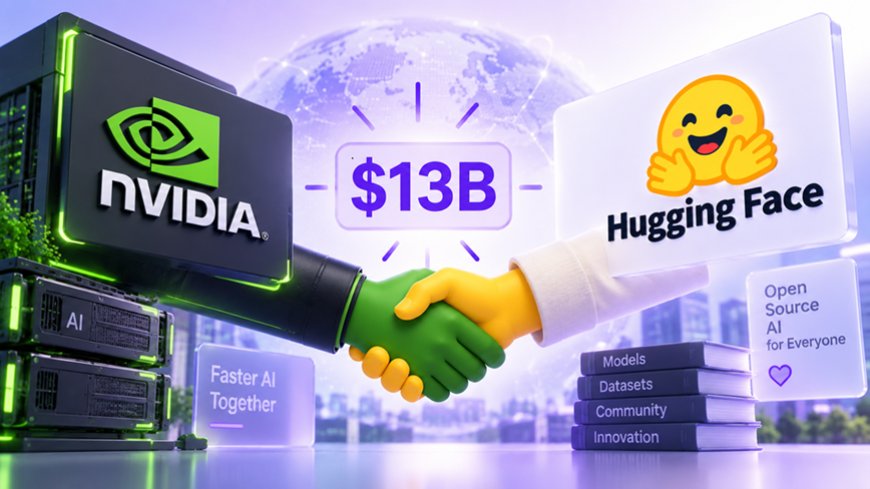
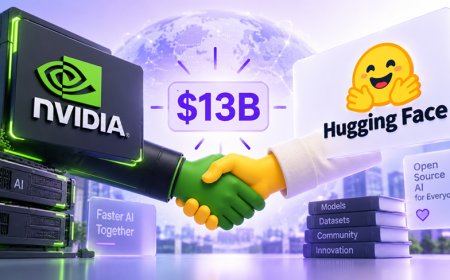
Nvidia just agreed to pay close to $13 billion for Hugging Face, the platform millions of AI developers use every day to download and share models. It's the clearest sign yet that the world's most valuable chipmaker isn't content with just selling the hardware AI runs on—it wants to own the shelves where the AI itself sits.
What's actually in the deal
Hugging Face is the closest thing the AI world has to a public library: over 18 million developers, researchers and hobbyists use it to host and download more than 3 million models, half a million datasets and a million-plus applications. Roughly 200,000 companies rely on it to find and deploy AI rather than build everything from scratch. Nvidia's deal, first reported by Bloomberg and CNBC and confirmed through Nvidia's own announcement, values the company at nearly $13 billion and is expected to close in the first half of 2027, pending regulatory approval—the government sign-off that antitrust regulators in the US and EU typically require before a deal of this size can go through.
It's Nvidia's second-largest acquisition ever, behind only the roughly $20 billion it spent on Groq's assets late last year. Nvidia isn't new to Hugging Face either; it was one of the investors who put in $235 million during the startup's 2023 funding round. The company can afford it: Nvidia became the first $5 trillion public company on the back of the AI chip boom, and it's now spending that valuation on locking down every layer of the AI stack, not just the silicon.
Nvidia CEO Jensen Huang said the deal "will expand access to AI for developers and institutions worldwide," and that the company intends to keep Hugging Face's platform open and run it consistent with the startup's existing practices.
Why a chipmaker wants a model-hosting site
The logic isn't complicated once you follow the money. Open-weight models—AI models whose underlying parameters are published for anyone to download and run, unlike closed systems from OpenAI or Anthropic that you can only access through an API—are catching up fast to proprietary alternatives. A healthy open-source ecosystem gives companies more places to get good AI without paying a closed lab, and every one of those open models still needs GPUs to run on. The more open-source AI thrives, the more chips Nvidia sells. Owning the biggest distribution point for that ecosystem gives Nvidia a front-row seat and a steering wheel at the same time.
That's also exactly what worries some of Hugging Face's own community. Developers have been split in their reaction: some think Nvidia has earned enough goodwill through its past investment and hardware support to be trusted stewards. Others are more wary, pointing to the old "embrace, extend, extinguish" playbook big tech companies have used before—support an open standard until you control it, then quietly bend it toward your own products. A platform is only as neutral as its owner wants it to be.
Why this matters in India specifically
India doesn't just use Hugging Face casually—it's one of the platform's largest developer bases anywhere in the world. A large chunk of the country's homegrown AI work, from Indic-language chatbots to fine-tuned models built by startups that can't afford to train from scratch, is downloaded straight off Hugging Face rather than licensed from a closed API. That makes platform neutrality a very direct, practical concern for Indian builders: will pricing, access or featured placement start quietly favoring Nvidia's own AI stack once the deal closes? For a startup ecosystem that leans heavily on free and open tooling to compete with better-funded rivals in the US and China, who owns the library matters almost as much as what's on the shelves.
There's also a policy angle worth watching. India's AI ambitions, from government-backed language models to startup tools built for Indian users, lean heavily on infrastructure the country doesn't own or control. A single chipmaker owning both the hardware and a dominant share of the model-distribution layer is the kind of concentration competition regulators elsewhere are already scrutinizing, and it's a dependency Indian policymakers will need to factor in as they think about AI infrastructure sovereignty.
What to actually watch next
- Whether regulators in the US, EU or elsewhere flag the deal on antitrust grounds before it closes in 2027.
- Whether Hugging Face's free-hosting tiers and open licensing terms change once Nvidia is in charge.
- Whether rival chipmakers or cloud providers respond by backing a competing open-model hub.
- How Indian AI startups and researchers factor platform ownership into which models and tools they build on next.
None of this makes Hugging Face worse today, and Nvidia's public commitment to keep it open is a real one, not just PR boilerplate. But acquisitions change incentives slowly and quietly, long after the headlines fade. The real test isn't what Nvidia says this week—it's what quietly changes on hf.co eighteen months from now, once the deal has actually closed and nobody outside the AI world is paying attention anymore.
What's Your Reaction?
 Like
1
Like
1
 Dislike
0
Dislike
0
 Love
0
Love
0
 Funny
0
Funny
0
 Angry
0
Angry
0
 Sad
0
Sad
0
 Wow
0
Wow
0