






















Meta Muse Voice Transcribe Launches With 5 Indian Languages
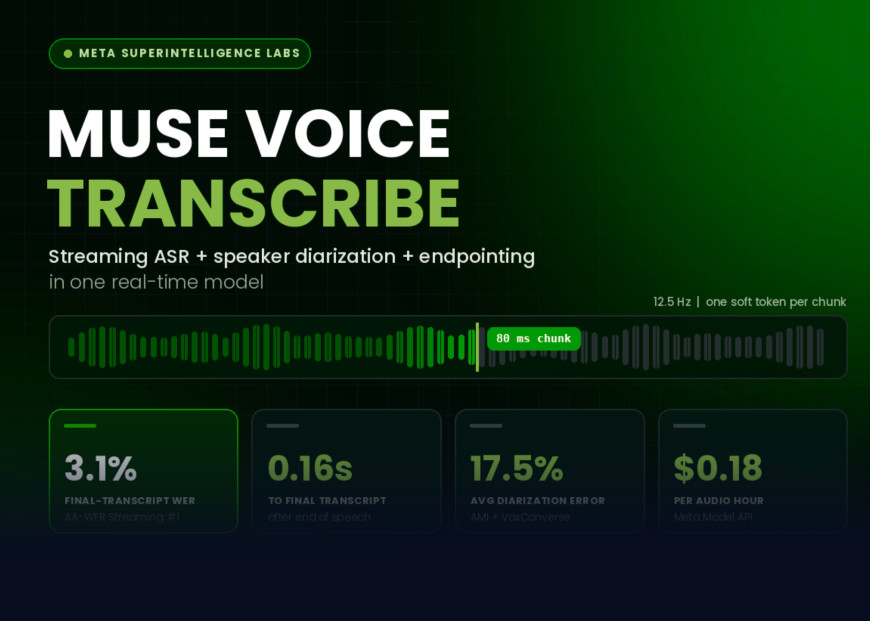
Meta's new real-time speech-to-text AI supports Hindi, Tamil, Telugu, Kannada and Malayalam. It handles code-switching and 20+ speakers for $0.18/hour.
Imagine dictating an email in Hinglish while your colleague switches to Tamil mid-sentence—and the transcript keeps up without missing a beat. That is the promise Meta is making with its newest AI model, launched on September 1 from the company's Superintelligence Labs.
What Muse Voice Transcribe Actually Does
Muse Voice Transcribe is a streaming speech-to-text model. Unlike older transcription tools that process an entire recording after you hit stop, this one generates text as you speak. Think of it like a stenographer who types in real time rather than a secretary who listens to a tape later.
The model handles three tricky tasks simultaneously in a single pass:
- Streaming ASR: Text appears as words are spoken, not after the recording ends.
- Speaker diarization: The model tags each sentence with who said it, even in conversations with 20 or more participants.
- Endpointing: It detects natural pauses and stops without manual intervention or separate cleanup.
- Code-switching: Speakers can flip between languages mid-sentence without breaking the transcript or forcing you to toggle settings.
Meta claims the model ranks first on the Artificial Analysis streaming speech-to-text leaderboard as of September 1, 2026. It processes audio in 80-millisecond chunks and decides word-by-word how long to wait before committing text, spending extra time on difficult words while rushing through simple ones.
Why the Indian Language Support Matters
Meta trained Muse Voice Transcribe on more than 70 languages, with 25 extensively validated at launch. Five of those are major Indian languages: Hindi, Tamil, Telugu, Kannada, and Malayalam. For a country where the vast majority of daily communication happens in regional tongues, this is not a minor feature—it is the difference between usable and useless.
Code-switching is the real headline here. In India, bilingual conversations are the norm, not the exception. Someone might begin a sentence in English, switch to Hindi for emphasis, and finish in Tamil. Traditional transcription models force you to pick one language per session. Muse Voice Transcribe handles arbitrary switching within or between sentences without manual toggling.
"The model ascertains delay on a word-by-word basis, allowing it to respond quickly to straightforward speech while spending more time on words that are harder to recognise."
This matters for Indian developers building voice apps, call centers handling multilingual customers, and journalists transcribing interviews across language barriers. The API is priced at $3 per 1,000 audio minutes—roughly $0.18 per hour—making it competitive with existing offerings from OpenAI's Whisper and Deepgram.
The Regulatory and Competitive Landscape
Meta's timing is notable. India's Ministry of Electronics and Information Technology introduced the 2026 Amendments to the IT Rules in February, imposing new obligations on platforms handling synthetically generated information and AI-powered content tools. While speech-to-text does not generate content, it feeds into pipelines that do. Any Indian startup integrating Muse Voice Transcribe into a customer-facing product will need to consider traceability and labeling requirements under the amended rules.
The competition is heating up too. OpenAI's Whisper has dominated developer mindshare for multilingual transcription, and Azure's Neural Voices already cover more Indian languages than Meta's initial 25. Google's speech APIs have supported Hindi and Tamil for years. Meta's edge lies in the combination of real-time streaming, speaker diarization, and code-switching in a single model—not in raw language count.
What Comes Next
Muse Voice Transcribe is available through Meta's Model API starting today. Meta AI for Mac and Muse Code already use it for dictation. Developers can integrate it into their own applications without managing separate post-processing pipelines.
For Indian users, the immediate impact is practical. A student in Chennai can record a lecture in Tamil and English mixed together. A founder in Bangalore can dictate notes that switch between Kannada and English. A doctor in Kerala can transcribe patient consultations in Malayalam without losing the English medical terms sprinkled throughout.
Whether this translates into widespread adoption depends on how well the model handles India's acoustic reality—noisy streets, thick accents, and patchy internet. The benchmarks look good. The real test starts now.
What's Your Reaction?
 Like
0
Like
0
 Dislike
0
Dislike
0
 Love
0
Love
0
 Funny
0
Funny
0
 Angry
0
Angry
0
 Sad
0
Sad
0
 Wow
0
Wow
0