





























OpenAI Cuts GPT-6 API Prices in Half With New Sol and Luna Models
OpenAI's new GPT-6 Sol and Luna models cut API pricing 50% or more, a shift that matters most for cost-sensitive Indian AI developers.
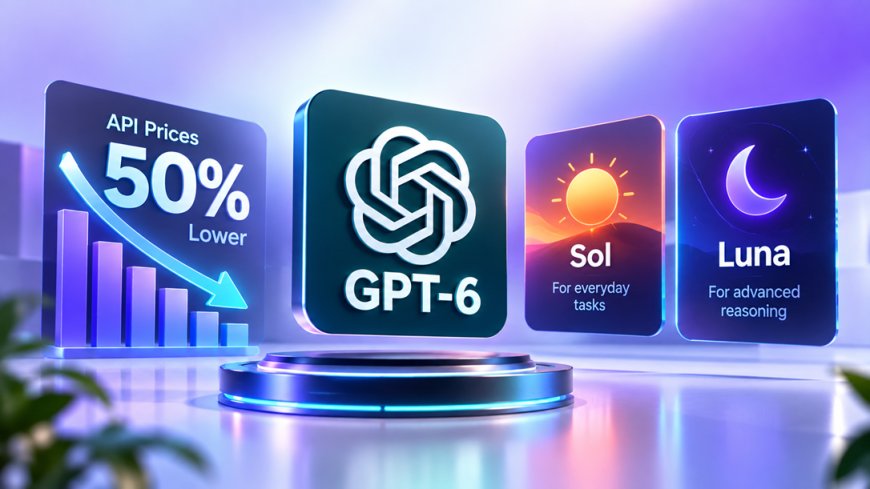
Building a coding assistant on GPT-6 used to cost four dollars for every million tokens you fed it and twenty dollars for every million it wrote back. As of this week, both those numbers have been cut in half, and OpenAI says the cut is permanent, not a launch-week promotion.
The company has released two updated models, GPT-6 Sol and GPT-6 Luna, alongside the price change. Tokens, if you haven't run into the term, are just the small chunks of text AI systems break your input and output into for billing and processing — a rough rule of thumb is about three-quarters of a word per token.
What Actually Changed
GPT-6 Sol now costs $2 per million input tokens and $10 per million output tokens, down from $4 and $20 under GPT-5.6 Sol. GPT-6 Luna, the smaller and faster model in the lineup, drops to $0.10 and $0.50 per million tokens, down from $0.20 and $1.20. OpenAI is also giving a 90% discount on cached input tokens — caching means the model reuses processing work from a previous request instead of redoing it from scratch, which is common when an app sends the same long system prompt or document over and over.
OpenAI credits the cut to upgrades in caching and inference, the process of actually running a trained model to generate a response, rather than to a cheaper or smaller model. On the company's own internal factuality tests, GPT-6 Sol makes roughly half as many mistakes as its predecessor. Independent early benchmarks, though, suggest the real-world performance jump is modest — this looks much more like a cost story than a capability leap.
“Improvements in caching and inference let us serve these models at lower cost, and we’re passing those savings directly on to users and customers,” OpenAI said in its announcement.
Why It Lands Differently in India
A price cut like this reads as a footnote in San Francisco and as a business-model decision in Bengaluru or Gurugram. Most Indian AI startups building on top of GPT-6 — customer support bots, coding copilots, document processing tools sold to enterprises at rupee price points — run on thin margins where API cost is the single biggest line item after payroll. Halving that cost either doubles runway for a bootstrapped team or lets them drop prices to compete with the wave of India-focused AI tools now shipping on cheaper open-weight models instead. It also raises the bar founders have to clear when they justify sticking with a closed, paid model at all, at a time when Indian developers have been experimenting more with free, self-hosted alternatives out of China.
The Bigger Pattern
This is not an isolated move. It follows OpenAI's flagship GPT-6 Astra launch earlier this month, and it lands the same week that Xiaomi open-sourced its own frontier-class MiMo-V2.6 models under a permissive MIT license. A few things stand out about where this is headed:
- API pricing across major AI labs has fallen sharply through 2026, not just at OpenAI
- Open-weight Chinese models are increasingly competitive on benchmarks while costing a fraction to run
- Labs are now competing on cost-per-token almost as visibly as they compete on raw capability
- For developers, the model that wins isn't always the smartest one, but the one that's cheap enough to run at scale
None of this is charity. OpenAI is defending market share against genuinely cheaper open alternatives, and a price war benefits exactly the builders who were priced out before. If you run a product on GPT-6 today, it's worth actually re-checking your monthly bill this week rather than assuming the savings apply automatically — cached-token discounts in particular depend on how your app is structured, not just which model you call.
What's Your Reaction?
 Like
0
Like
0
 Dislike
0
Dislike
0
 Love
0
Love
0
 Funny
0
Funny
0
 Angry
0
Angry
0
 Sad
0
Sad
0
 Wow
0
Wow
0