








































Google Launches Project Suncatcher, Sends AI Chips Into Space
Google launched TPU AI chips into orbit on a SpaceX rocket, testing whether space could one day host solar-powered AI data centers.
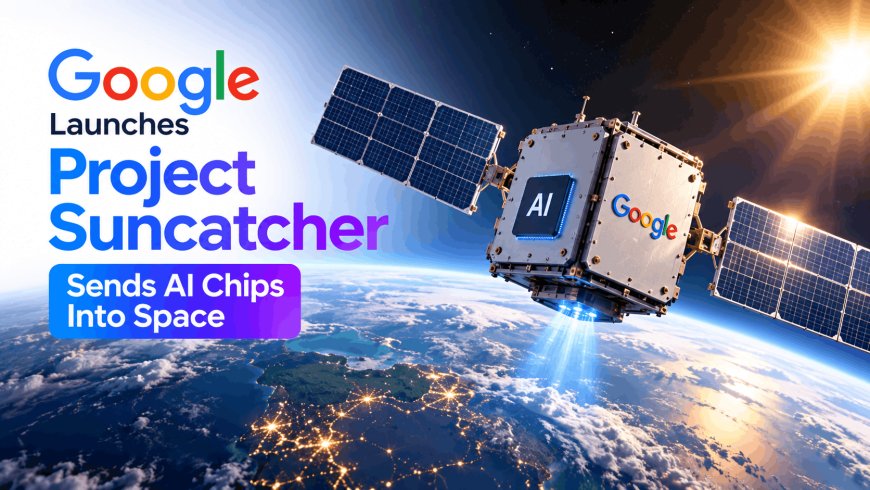
On October 1, a SpaceX Falcon 9 lifted off from Vandenberg Space Force Base carrying a satellite about the size of a home refrigerator. Tucked inside were four of Google's Trillium-generation TPUs — Tensor Processing Units, the custom chips that already run Gemini and most of Google's AI workloads on the ground. The mission has a name that sounds like it belongs in a pitch deck for a sci-fi film: Project Suncatcher.
The idea itself isn't new — Google first described it about a year ago — but this is the first time any hardware has actually left the ground. And what Google is trying to prove is a genuinely strange question for a software company to be asking: can an AI chip survive in space long enough to be useful?
What's actually flying up there
The satellite rode along on a SpaceX rideshare mission called Transporter-18, sharing a ride with a batch of unrelated payloads to keep costs down. Once in low Earth orbit (a band roughly 500-2,000 km up, where most communication and imaging satellites already live), the onboard TPUs will run short bursts of Google's Gemini AI models — about 15 minutes at a time before they need to pause and cool off. That's less a limitation of ambition and more a limitation of physics: chips generate heat, and space has no air to carry it away.
Google says the satellite is designed to stay operational for about a year, and the whole point is data collection, not production AI work. Engineers want to know how the chips hold up against:
- The violent vibration and g-forces of launch
- Cosmic radiation that would normally be filtered out by Earth's atmosphere
- Extreme temperature swings between sunlight and shadow
Cooling is handled through a combination of heat pipes and radiators, a design Google says was already tested on the ground inside a thermal vacuum chamber — a sealed chamber that mimics the airless, extreme-temperature conditions of orbit before anything is trusted to fly. Early signs, according to the company, are encouraging.
"Initial results have shown that our Trillium TPUs hold up remarkably well, and can survive a radiation total ionizing dose greater than what they would receive during a five-year space mission," Google said in a blog post announcing the test.
Why bother putting a data center in orbit at all
The pitch is solar power. A data center in space could, in theory, sit in near-constant sunlight and draw on solar energy that's roughly eight times stronger than what panels receive on Earth's surface, without ever worrying about clouds, nightfall, or land acquisition. AI training already eats enormous amounts of electricity, and that appetite is only growing. If you can't easily build more power plants fast enough near your data centers on the ground, building the data center where the sun never sets starts to look less absurd.
Google's long-term vision, laid out in a technical paper, goes well beyond one test satellite: a cluster of 81 satellites flying in tight formation about 650 km up, spaced 100-200 meters apart, linked to each other and to Earth by laser communication instead of radio. That's the scale at which space-based AI computing would need to operate to actually matter. A two-satellite demonstration constellation is targeted for 2027.
What this means for India's own AI power problem
India's data center boom is running into exactly the bottleneck Project Suncatcher is aimed at: power. Cities like Mumbai, Chennai, and Hyderabad have seen data center capacity multiply in the last few years, largely to host AI workloads, and grid operators and land acquisition have struggled to keep pace. India is also one of the world's biggest solar markets by installed capacity, which is precisely the resource Google is trying to tap from orbit instead of from a rooftop.
India's commercial space sector has its own momentum here too. Bengaluru-based Pixxel recently raised $100 million in India's largest-ever space-tech funding round, and startups like Kepler Aerospace are building satellite constellations of their own under the IN-SPACe policy framework that opened up the sector to private players. None of them are building orbital data centers yet, but the underlying hardware, satellite manufacturing, and launch expertise required for something like Suncatcher is an area Indian space startups are actively trying to compete in. A large chunk of Google's own TPU and AI infrastructure engineering, for what it's worth, is also done out of its Bengaluru and Hyderabad campuses.
The catch nobody's glossed over
None of this is close to replacing a terrestrial data center. Four chips running in 15-minute bursts is a research experiment, not a product. Launch costs, radiation-hardening, repair logistics (you can't send a technician to fix a satellite), and the sheer complexity of cooling chips in a vacuum are unsolved problems, not solved ones. Google has previously leaned on massive ground-based solar deals, as Meta has too, which is a far cheaper and faster way to feed AI's power habit than rocketing hardware into orbit.
What Project Suncatcher really signals is how seriously the biggest AI companies are now taking the energy question. When a search company starts talking about satellites and launch windows instead of just chips and data centers, it's a fairly clear sign that electricity, not just compute, has become the real constraint on how much AI the world can build.
What's Your Reaction?
 Like
0
Like
0
 Dislike
0
Dislike
0
 Love
0
Love
0
 Funny
0
Funny
0
 Angry
0
Angry
0
 Sad
0
Sad
0
 Wow
0
Wow
0