







































Pixxel Raises $100 Million in India's Largest Space-Tech Round
Bengaluru's Pixxel raised $100M in India's biggest-ever space-tech funding round, expanding from hyperspectral satellites into orbital data centres.
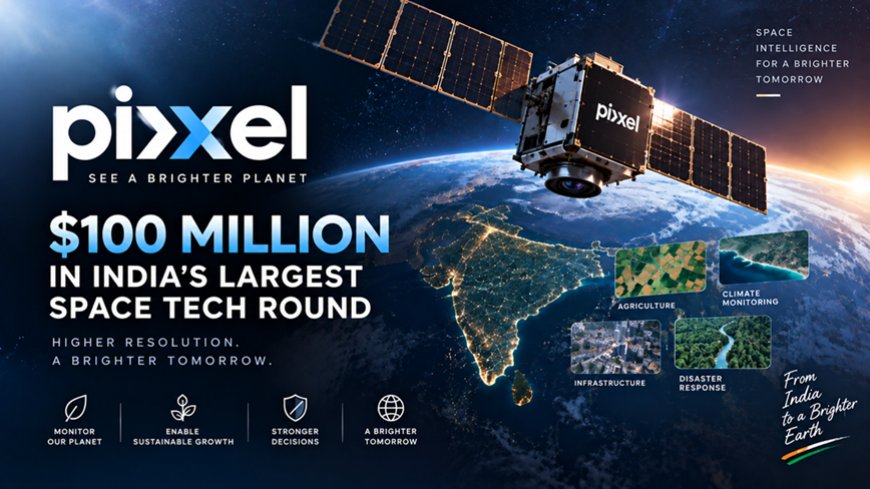
Two engineers who started out flying a student nanosatellite for ISRO's campus programme have just closed the largest funding round any Indian space company has ever raised. Pixxel, the Bengaluru-founded hyperspectral imaging startup, announced on September 7 that it has pulled in $100 million in Series C funding, co-led by Temasek and Seraphim Space.
From a BITS Pilani dorm room to orbit
Awais Ahmed and Kshitij Khandelwal founded Pixxel in 2019 after working on Team Anant, the student satellite group at BITS Pilani that operates under ISRO's student nanosatellite programme. Seven years later, the company runs a constellation of six Firefly satellites that don't just take pictures of Earth — they see things ordinary cameras can't.
That's the whole pitch, and it's worth explaining because it's genuinely different from a regular camera in orbit. Most Earth-imaging satellites capture three colour bands — red, green, blue — the same as a phone camera. Pixxel's satellites are hyperspectral, meaning they read light across more than 150 narrow bands of the spectrum, well beyond what the human eye can register. That lets the data reveal things like crop stress, chemical leaks, or water contamination days before they'd be visible to a normal satellite image or the naked eye.
New investors 360 ONE Asset and South Korea's IMM Investment joined the round alongside returning backers including Radical Ventures and the Bengaluru-based growX ventures. The raise takes Pixxel's total funding to $195 million and, as the company put it in its own announcement, positions it as the best-capitalised private space technology company in Indian history.
Beyond pictures: satellites, software, and now data centres in orbit
What's notable about this round is that Pixxel isn't spending it purely on more cameras. The company says the money will fund an expansion from hyperspectral imaging into a broader "planetary infrastructure" business — combining sensing satellites, Earth-intelligence software, and satellite manufacturing for government and sovereign customers.
The most eye-catching piece of that expansion: Pixxel has also outlined plans for an orbital data-centre demonstration satellite, building on a partnership it struck earlier this year to explore putting computing infrastructure — not just cameras — into space. It's a bet that as AI workloads grow, some of that processing might eventually make more sense done in orbit, closer to where the data is captured, than beamed down to ground stations first.
Pixxel's satellites are already producing imagery used by NASA for Earth science modelling, alongside contracts with the Indian agriculture ministry, energy major BP, and — reported earlier this year — the US National Reconnaissance Office, the American intelligence agency that operates spy satellites. That customer list matters: it shows a company that started as a scrappy campus project is now trusted with data for institutions that don't take vendor selection lightly.
"Years ago, we set out to build a health monitor for the planet," said Pixxel founder and CEO Awais Ahmed. "Hyperspectral imaging gave us a fundamentally new way to see Earth. This new investment gives us the scale to turn that vision into planetary infrastructure... Our goal is to make a changing planet understandable in time to act."
Why this matters for India's own space ambitions
For Indian founders and engineers watching the space-tech space, Pixxel's round is a signal that deep tech — not just software or fintech — can raise serious global capital while staying headquartered in India. It also arrives as India's private space sector keeps gathering pace: just days earlier, Bengaluru's Kepler Aerospace raised $8 million to build swarming reconnaissance satellites, part of a broader wave of startups building on the access ISRO and the government's 2020 space-sector liberalisation opened up.
There's a sovereignty angle too. As more countries — India included — push to build their own satellite-based intelligence, agriculture-monitoring, and disaster-response capability rather than depend entirely on foreign providers, companies like Pixxel sit at a genuinely strategic intersection of private enterprise and national interest. A hyperspectral constellation that can flag a crop disease outbreak or a chemical spill early is exactly the kind of infrastructure India's own ministries have started buying.
- $100 million Series C, co-led by Temasek and Seraphim Space
- Total funding to date: $195 million — India's largest private space-tech raise
- Six operational Firefly hyperspectral satellites, 550km orbit
- Customers include NASA, BP, India's agriculture ministry, and reportedly the US NRO
- New focus: orbital data-centre infrastructure alongside Earth observation
The bigger story here isn't just one large cheque. It's a reminder that some of the most capital-intensive, hardest-to-fake deep tech categories — the ones that take years of hardware iteration before they produce revenue — now have credible Indian players building at the frontier, not just following it.
What's Your Reaction?
 Like
0
Like
0
 Dislike
0
Dislike
0
 Love
0
Love
0
 Funny
0
Funny
0
 Angry
0
Angry
0
 Sad
0
Sad
0
 Wow
0
Wow
0