































OpenAI's Jalapeño Chip Beats Nvidia Blackwell in New Benchmarks
OpenAI's new Jalapeño inference chip beat Nvidia's Blackwell in independently verified benchmarks — a first for AI's biggest GPU buyer.
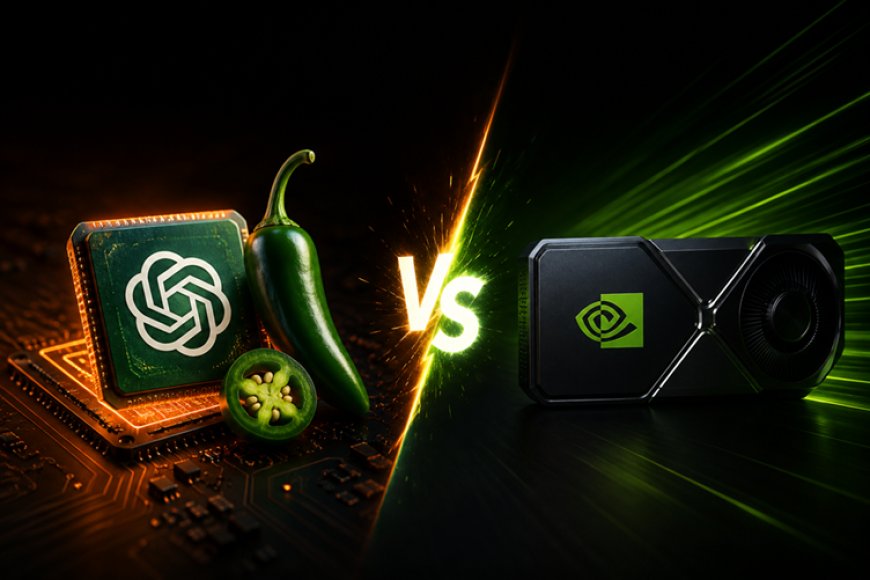
At a chip conference in California this week, OpenAI did something it has never done before: put its own hardware up against Nvidia's best gear, in public, with independent verification, and came out ahead.
What OpenAI actually showed
The chip is called Jalapeño, and it's built for what's known as inference — not the training runs that teach an AI model, but the everyday work of actually answering a prompt once the model already exists. Every time you ask ChatGPT something, an inference chip somewhere is doing the math to generate that reply, and doing it fast and cheap at inference time is now just as important to OpenAI's business as the training itself.
At Hot Chips — an annual conference where chipmakers show off their latest silicon to engineers — on August 25, OpenAI published its first real benchmark numbers for Jalapeño, run against Nvidia's Blackwell systems on public AI models. The results were checked independently by SemiAnalysis, a semiconductor research firm whose engineers visited OpenAI's labs and ran the workloads themselves rather than taking the company's word for it. That step matters — first-generation chips from companies new to hardware usually underperform, and a vendor's own numbers are easy to dismiss.
- 1.5x to 1.9x more work per watt than the Blackwell configurations it was tested against
- End-to-end response times cut by 1.7x to 3.6x
- On the kind of fast, conversational traffic ChatGPT generates, Jalapeño ran 2.1x to 4.1x faster
Jalapeño was co-developed with Broadcom on the silicon and networking side and Celestica on systems integration, part of a deal the two companies struck back in October 2025 to build out 10 gigawatts of custom AI accelerators together.
Why a customer building its own chips is a big deal
OpenAI is, by most accounts, Nvidia's single largest customer. A company that big walking on stage and showing benchmark charts where its own silicon beats Nvidia's flagship product is a different kind of statement than the usual chip-launch hype. As we covered when Nvidia crossed a $5 trillion valuation, that company's dominance has been built partly on the fact that nobody serious has managed to seriously challenge it on performance. Jalapeño doesn't end that dominance overnight — OpenAI itself says only a small-scale deployment is planned by the end of 2026, with a bigger rollout in 2027 — but it's the clearest sign yet that the biggest AI labs are done being fully dependent on one supplier.
"The bottom line is that the results show a very, very significant performance advance over state of the art," said Richard Ho, OpenAI's head of hardware, on a press call.
SemiAnalysis was blunter in its own writeup, noting that Jalapeño "beats Blackwell… across almost all scenarios without being tuned for any specific point in the curve."
What it means from India
This isn't just a Silicon Valley story. India's own AI push — from the government's IndiaAI Mission GPU procurement to homegrown model builders like Sarvam AI and Krutrim — has run almost entirely on Nvidia hardware, because for years there hasn't been a credible alternative at the performance level serious AI work needs. A shift like this, even a small one, is a preview of a world where Indian cloud providers, data centres and AI startups have more than one hardware vendor to negotiate with, which matters a lot when GPU supply and pricing have been a genuine bottleneck for Indian AI infrastructure.
There's a more immediate angle too: OpenAI's API pricing is a real line item for a growing number of Indian startups building products on top of ChatGPT and GPT models. If cheaper, faster inference chips let OpenAI bring its own compute costs down, that's the kind of change that eventually shows up in API pricing — the same way it did when cloud computing costs fell as data centres got more efficient.
What comes next
Nvidia isn't standing still, and one benchmark cycle doesn't settle an industry. But the direction is clear: the AI labs with the money to do it are all trying to own more of their own hardware stack, the way Google has with its TPUs for years. For a market that has effectively had one dominant supplier, even a credible second option changes the negotiating table — for OpenAI, for Nvidia's other big customers, and eventually for anyone building on top of these models, wherever they're building from.
What's Your Reaction?
 Like
1
Like
1
 Dislike
0
Dislike
0
 Love
1
Love
1
 Funny
0
Funny
0
 Angry
0
Angry
0
 Sad
0
Sad
0
 Wow
0
Wow
0