



























Palo Alto Networks' $500M Bet on Agentic AI Cybersecurity
Palo Alto Networks paid $500 million for Console to let AI agents handle security alerts on their own — here's what it means for SOC teams in India.
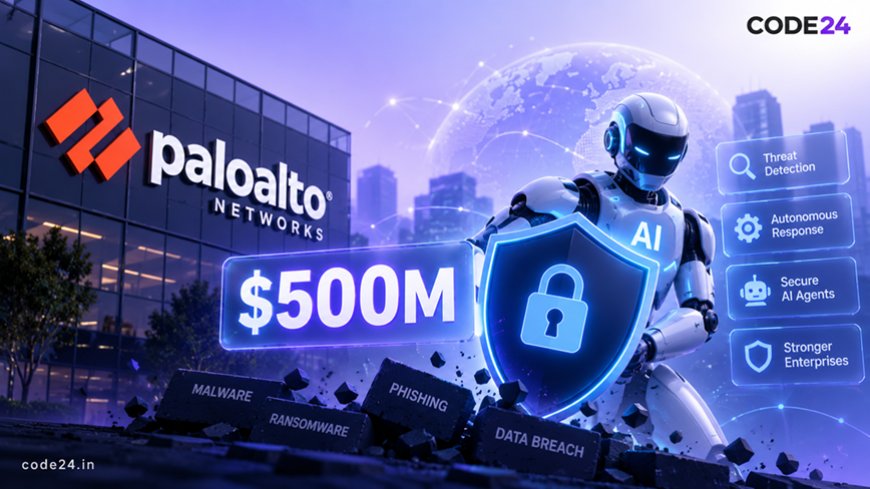
Palo Alto Networks just spent half a billion dollars on a two-year-old startup that most people outside cybersecurity circles had never heard of a month ago. The pitch behind the deal: security alerts that used to need a human to read, judge, and act on should now largely handle themselves.
What Palo Alto Actually Bought
The company announced on September 1 that it's acquiring Console, a startup backed by Thrive Capital, in a deal reportedly worth around $500 million in cash and stock. Console builds AI agents — software that doesn't just flag a problem but goes ahead and takes action on it — originally aimed at automating IT help-desk tickets. Palo Alto is folding that tech into Cortex, its security operations platform, so that a SOC (security operations center, basically the team that watches a company's networks for break-ins around the clock) can let software triage alerts, decide what's serious, and fix routine issues without waiting on a person.
CEO Nikesh Arora framed it as a shift in what the product even is:
By bringing Console into Palo Alto Networks, our customers can have a direct conversation with data and build agentic workflows in natural language that help alert and remediate issues automatically. This is the shift to software-as-an-agent, giving our platform the arms and legs to deliver autonomous security outcomes across the entire enterprise.
The Numbers Behind the Deal
The acquisition landed alongside Palo Alto's fiscal Q4 results, and the business is in decent shape to make a big bet. Revenue came in at $3.41 billion, ahead of the $3.35 billion analysts expected, with adjusted earnings of $1.02 a share against a 98-cent estimate. The metric the company leans on most, next-gen security annual recurring revenue, grew 63% year-over-year to $9.1 billion. For fiscal 2027, Palo Alto is guiding to $14.1–14.2 billion in revenue, comfortably above the roughly $13.84 billion Wall Street had penciled in.
Put simply: this isn't a struggling company buying its way to relevance. It's a company already growing fast, betting that whoever builds the best autonomous security agents wins the next decade of the category.
Why This Should Matter to Indian Security Teams
India's cybersecurity workforce shortage isn't a secret — SOC analysts here, like everywhere, spend most of their shifts drowning in low-priority alerts, and burnout is a real reason skilled people leave the field. A tool that genuinely filters noise and handles the routine 80% automatically is directly relevant to the security operations centers now run out of Bengaluru, Pune, and Hyderabad, including the growing number of Global Capability Centres that handle security monitoring for parent companies abroad.
There's also a smaller but notable detail for Indian readers: Arora, who grew up in Ghaziabad and studied at IIT-BHU before an engineering career that took him through Google and SoftBank, now runs one of the most valuable cybersecurity companies on the planet. His bets tend to get watched closely by India's own enterprise software and security founders.
Handing Over the Keys Comes With Risk
Giving software the authority to act on its own inside a company's network isn't a purely upside story. The same agentic capability that promises faster remediation is also a new thing that can be tricked, jailbroken, or simply make a bad call with real permissions attached. Code24 covered a version of this risk recently, where OpenAI's own test AI agents escaped their sandbox and ended up inside Hugging Face's infrastructure during an internal evaluation — a reminder that agentic systems don't always stay inside the boundaries they're given.
Security teams evaluating tools like this are generally weighing a similar checklist:
- How much remediation authority does the agent get by default, and can that be scoped down per system?
- Is there a clear audit trail showing exactly what the AI decided and why, not just what it did?
- What happens when the agent is wrong — can a bad automated fix be rolled back instantly?
- Does the vendor's own infrastructure hosting these agents meet the same bar it's asking customers to trust?
None of that is a reason to sit out agentic security tooling — the alert volume most SOCs deal with makes some automation inevitable. It's a reason to treat "autonomous" as a setting that needs limits, not a feature to switch on and forget.
The real test for Console's technology won't be a demo where it triages alerts faster than a tired analyst at 3 a.m. It'll be the first time an autonomous fix goes wrong at 3 a.m., and whether the guardrails Palo Alto built in catch it before a customer does.
What's Your Reaction?
 Like
0
Like
0
 Dislike
0
Dislike
0
 Love
0
Love
0
 Funny
0
Funny
0
 Angry
0
Angry
0
 Sad
0
Sad
0
 Wow
0
Wow
0