





































Anil Chakravarthy to Replace Shantanu Narayen as Adobe CEO
Adobe names IIT-BHU grad Anil Chakravarthy as CEO, succeeding fellow Indian-origin leader Shantanu Narayen this December.
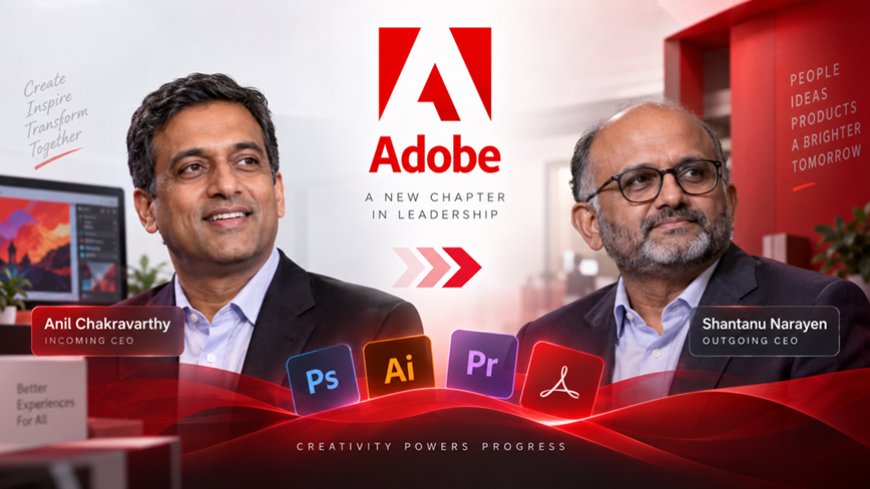
Adobe just handed its corner office to a second straight Indian-origin engineer. On December 1, Anil Chakravarthy takes over as president and CEO from Shantanu Narayen, who is stepping back after more than 18 years running the company, moving into the role of executive chair.
Who is Anil Chakravarthy
Chakravarthy grew up in Bengaluru and studied computer science at IIT (BHU) Varanasi before heading to MIT for a master's and a PhD. His path to the top wasn't a straight line through Adobe, either. He cut his teeth at McKinsey, held security leadership roles at Symantec and VeriSign, and then spent five years as CEO of Informatica, where he pushed the enterprise data company through a messy but ultimately successful shift to the cloud. He joined Adobe in 2020 to run its Digital Experience division, and over the past few years has quietly become the executive most directly responsible for how Adobe sells to big companies.
That last part matters. Adobe's stock has been under pressure this year, and it's not because Photoshop got worse — it's because investors are worried that generative AI tools are going to eat into the demand for Adobe's creative and marketing software before Adobe can turn its own AI bets into real revenue. Handing the CEO job to the person who's spent years running enterprise sales and customer relationships is Adobe signaling that retention and monetization, not just flashy AI demos, are the priority now.
Narayen, in the announcement, credited Chakravarthy's "deep operational discipline and customer focus" as central to the decision — a pointed way of saying the next chapter is about execution, not just invention.
Why this is bigger than one company's org chart
It's easy to read this as routine succession planning, but the pattern underneath it is hard to ignore. Adobe will have had back-to-back Indian-origin CEOs — Narayen himself was born in Hyderabad — at the head of a company that essentially invented the modern creative software category. That's not a coincidence limited to one firm, either. A large share of Silicon Valley's biggest technology companies are currently run by executives who did their undergraduate engineering somewhere in India before moving to the US for graduate school, and Adobe's transition just adds one more data point to that list.
For Indian engineering graduates, especially the ones coming out of the IITs, this is the career template that gets talked about constantly: an undergraduate degree from an Indian engineering institute, a master's or PhD from a top American university, and then two decades of grinding through operational roles before the top job. It's a well-worn path, but it's still remarkable how consistently it keeps producing outcomes like this one.
The India connection isn't just symbolic
There's a more concrete India angle here too. Adobe has been steadily deepening its India bets under the outgoing leadership — it acquired the Bengaluru-founded AI startup Rilo just last week to bolt agentic AI features onto its marketing tools, on top of its earlier purchase of Rephrase.ai. Adobe also runs one of its largest engineering and R&D centers globally out of Noida and Bengaluru, employing thousands of Indian engineers who build core pieces of Photoshop, Acrobat, and Adobe's cloud infrastructure — not just support functions.
A CEO who grew up navigating that same ecosystem, and who has spent the last several years overseeing exactly the kind of enterprise and customer-experience products Adobe is trying to defend from AI-native competitors, gives that India operation a louder voice inside the company's strategic decisions. It also puts Chakravarthy in an interesting spot as India tightens its own approach to data and AI governance under the DPDP Act (the country's new personal data protection law) — an Adobe run by someone who understands both the Silicon Valley boardroom and the Indian engineering pipeline is arguably better positioned to navigate that than most of its rivals.
What comes next
The handover isn't instant. Narayen stays involved as executive chair through the transition, and Chakravarthy doesn't formally take the CEO title until December. In the meantime, expect Adobe to keep talking up its AI roadmap — Firefly, its own image and video generation models, and deeper AI features across Creative Cloud — because that's the fight Chakravarthy is inheriting.
- Chakravarthy formally becomes CEO on December 1, 2026
- Narayen moves to executive chair after 18-plus years as CEO
- Adobe's stock has slipped this year on fears that AI tools will erode demand for its core software
- Chakravarthy previously ran Adobe's Digital Experience business and was CEO of Informatica
Succession stories at big tech companies usually fade from the news cycle within days. This one is worth remembering less for the leadership change itself and more for what it says about where the next generation of global tech leadership keeps coming from — and how much of Adobe's future now runs through people, products, and decisions shaped in India.
What's Your Reaction?
 Like
0
Like
0
 Dislike
0
Dislike
0
 Love
0
Love
0
 Funny
0
Funny
0
 Angry
0
Angry
0
 Sad
0
Sad
0
 Wow
0
Wow
0