




































Barclays Wants Half Its Developers Coding With Claude AI by 2026
Barclays is scaling Anthropic's Claude across coding, legacy systems, and client operations, aiming for half its developers using it by year-end.
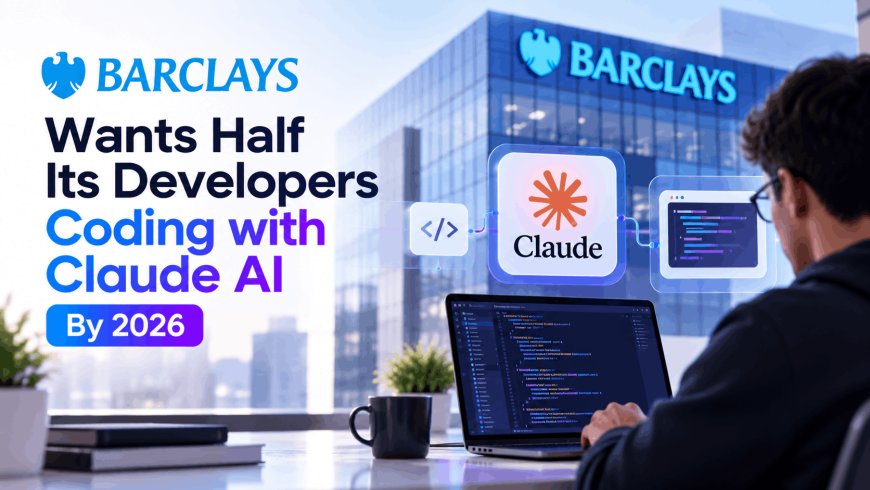
Barclays just put a number on how fast it expects AI to take over its engineering floor: half of its developers coding with Anthropic's Claude by the end of this year, and most of them by 2027. That's not a pilot program anymore. That's a bank restructuring how its software actually gets written.
What Barclays Is Actually Doing
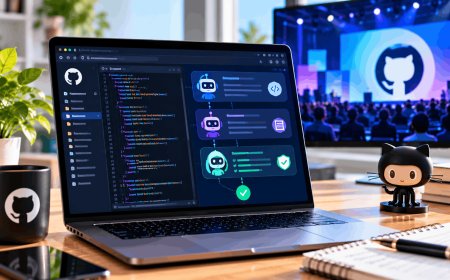
On October 1, Barclays and Anthropic announced an expanded partnership that goes well beyond a chatbot bolted onto an intranet. The bank is deploying Claude Code, Anthropic's AI coding agent, across its global engineering teams, using it to write new software, untangle decades-old legacy systems (the old core-banking code, often written in languages like COBOL, that most big banks still quietly run on because replacing it is too risky and expensive), and strengthen cyber defenses.
It's not a cold start. Barclays' Colleague Knowledge Assistant, built on Claude, is already used by more than 16,000 employees supporting roughly 20 million UK retail customers, and has handled over a million internal searches since it launched in 2025. In the bank's Global Markets division, Claude already sorts and routes around 120,000 client emails a day, which previously meant real people triaging an avalanche of inboxes by hand.
Paul Smith, Anthropic's Chief Commercial Officer, put the scale of it plainly:
Claude now helps 16,000 Barclays' colleagues find answers for customers, sorts 120,000 emails a day.
Craig Bright, Barclays' Group Co-Chief Operating Officer, framed it as an industry-wide shift rather than a one-off bet: "Software engineering and cyber security are both being reshaped by increasingly capable AI systems."
Why a 160-Year-Old Bank Is Moving This Fast
Banks are usually the last to touch anything new in their core systems, for good reason — a bug in payment processing isn't a minor inconvenience, it's a regulatory incident. So the areas Barclays is actually using Claude in tell you where banks think AI has crossed from "interesting demo" to "safe enough to trust with real money and real customer data":
- Writing and reviewing production code, with Claude Code used directly by engineering teams
- Modernizing legacy systems that are too brittle and too critical to rewrite carelessly
- Classifying and routing high-volume client communication in Global Markets
- Finding and helping patch security vulnerabilities before attackers do
None of that is generative flourish — it's operational plumbing. That's usually the tell that an AI tool has moved from novelty to infrastructure.
What This Means for India's Own AI-in-Banking Push
This lands differently for Indian readers than it does for a UK retail customer. Barclays runs some of its largest engineering and operations hubs out of India, in cities like Pune and Chennai, employing thousands of software engineers who work on exactly the kind of legacy modernization and global-markets tooling this announcement is about. When a bank says it wants half its developers on an AI coding agent within months, a huge chunk of that workforce sits in Indian offices, not London ones — which makes this as much a story about Indian tech jobs and skilling as it is about Wall Street or Canary Wharf.
It also arrives as Indian banks and regulators are having their own version of this debate. The RBI has been pushing its own framework for responsible AI adoption in financial services, partly because Indian banks — from HDFC to ICICI to the public-sector lenders — are under similar pressure to automate without creating new risks around data handling, bias, or outages. A foreign bank publicly committing to AI-written production code at this scale will likely accelerate those conversations here, both among Indian banks deciding how fast to move and among the engineers inside India's banking-tech centers wondering what their job looks like in two years.
The Part Nobody's Saying Out Loud
Barclays and Anthropic are careful to frame this as augmentation, not replacement — Anne Marie Darling, Barclays' other Group Co-Chief Operating Officer, said the true measure of any technology is the impact it has on customers, clients, and colleagues. That's true, but it dodges the actual question every bank's engineering org is quietly asking: if one developer with Claude Code can do what two could before, headcount plans don't stay the same by accident. Barclays isn't claiming otherwise — it just hasn't said the quiet part yet. For a market like India, where banking-tech employment has been a reliable growth story for two decades, that's the detail worth watching closer than the press release lets on.
What's Your Reaction?
 Like
0
Like
0
 Dislike
0
Dislike
0
 Love
0
Love
0
 Funny
0
Funny
0
 Angry
0
Angry
0
 Sad
0
Sad
0
 Wow
0
Wow
0