




































Google Tests Flipkart 'Buy' Button Inside Gemini and AI Mode in India
Google is testing a Flipkart 'Buy' button inside Gemini and AI Mode, letting Indian shoppers check out without leaving the chat.
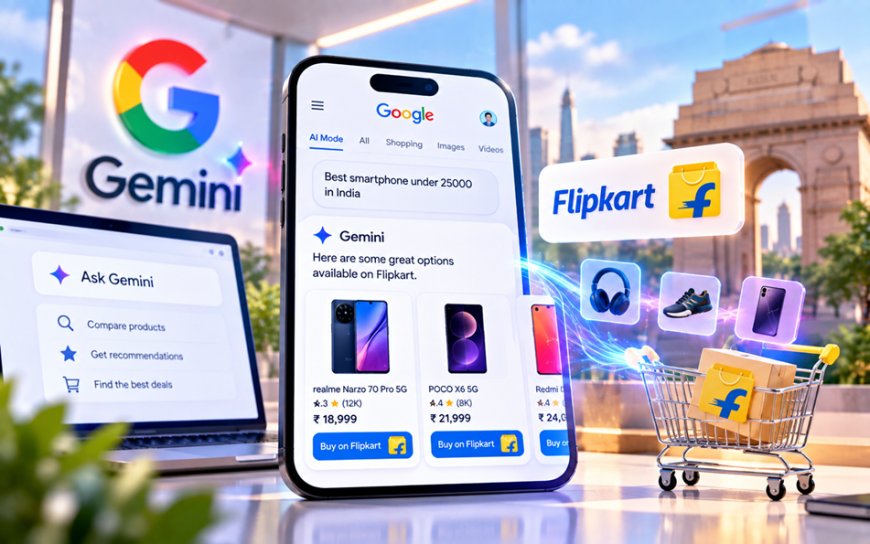
Open Gemini on your phone right now, search for a pair of wireless earbuds, and in a small test group in India, you might see something new next to the Flipkart listing: a plain "Buy" button. Tap it, and you're dropped straight into a Flipkart checkout screen without ever leaving the chat window.
That's the experiment Google has quietly started running this week, according to reporting from TechCrunch. It's a narrow test for now — limited to a slice of users and a small catalogue of smartphones, electronics and mobile accessories — but the timing is not an accident. Google wants this working at scale before India's festive shopping season hits in October, when Flipkart, Amazon and Meesho fight for the country's biggest online sales weeks of the year.
What's actually changing
Right now, when you ask Gemini or Google's AI Mode (the conversational search experience Google has been rolling into regular search results) about a product, it can show you listings, compare prices, and summarise reviews. What it can't do — until this test — is let you actually complete the purchase inside that same window. You'd still have to click through to Flipkart's app or site, log in, and check out separately.
The new flow collapses that gap. According to the reporting, tapping "Buy" hands you off to a Flipkart-branded checkout, not a Google-hosted one. That's a notable detail, because Google spent much of this year pushing something called the Universal Commerce Protocol (UCP) — an open standard meant to let AI agents handle an entire purchase, including payment, inside Google's own checkout experience. This Flipkart test doesn't use that. It's a simpler handoff: Google surfaces the product, Flipkart still owns the transaction.
A shopping assistant that only ever recommends things isn't much of an upgrade on search. One that can actually finish the purchase is a different product entirely — and Google is choosing India to find out whether that works.
That distinction — a Flipkart-run checkout rather than a Google-run one — matters for anyone watching how "agentic commerce" (the industry's term for AI systems that don't just recommend products but complete transactions on your behalf) actually gets built in practice versus how it gets pitched in keynotes.
Why India is the test bed, not an afterthought
It's worth pausing on the fact that this isn't a US pilot being localised later — India is where Google chose to start. That's a function of scale: India has well over half a billion smartphone users doing product research through search and chat apps daily, and festive-season online shopping (Diwali, in particular) is one of the largest concentrated e-commerce events anywhere in the world. Flipkart, majority-owned by Walmart, is the natural first partner precisely because it already commands a huge share of that festive traffic.
For Indian shoppers, the practical upside is fewer taps between "I want this" and "it's ordered" — useful on a slow mobile connection or an older phone where switching between apps is genuinely annoying. For Indian sellers on Flipkart, particularly small and mid-sized ones who rely on festive-season volume, an AI-surfaced buy button could mean a new, high-intent traffic source, provided their listings get selected for the test at all.
There's a regulatory angle too. India's Consumer Protection (E-Commerce) Rules already require clear disclosure of who a seller is, return policies, and grievance mechanisms on any e-commerce interface — and it's an open question whether an AI chat window showing a "Buy" button will be held to the same disclosure standard as a full Flipkart product page. MeitY (the Ministry of Electronics and IT) has been increasingly active on how AI-driven interfaces handle consumer-facing commitments, and a checkout embedded inside a chatbot is exactly the kind of new interface that regulation hasn't caught up with yet.
The bigger race this fits into
Google isn't moving in isolation. OpenAI has been building its own shopping and checkout features into ChatGPT, and Perplexity has run similar commerce experiments. Everyone building a general-purpose AI assistant is trying to answer the same question: does the assistant just help you decide, or does it also handle the money? Whoever gets that right first captures a transaction fee, first-party purchase data, and — most valuably — the habit of shoppers defaulting to their assistant before opening any retail app directly.
- The test currently covers a narrow set of categories — smartphones, electronics, and mobile accessories — not a general marketplace
- Checkout stays on Flipkart's systems, not Google's, at least for now
- A broader rollout is expected in October, timed to India's festive shopping rush
- It sits apart from Google's own Universal Commerce Protocol, which envisions a Google-hosted checkout instead
Whether this becomes a permanent fixture of Indian online shopping or a quietly shelved experiment probably won't be clear until after Diwali sales numbers come in. But the direction is unmistakable: search is turning into a storefront, one "Buy" button at a time, and India is where that shift is being tested first — which means Indian consumer protection rules are about to be tested right along with it.
What's Your Reaction?
 Like
0
Like
0
 Dislike
0
Dislike
0
 Love
0
Love
0
 Funny
0
Funny
0
 Angry
0
Angry
0
 Sad
0
Sad
0
 Wow
0
Wow
0