

































CrowdStrike's $495M Bet on Taming Rogue AI Agents
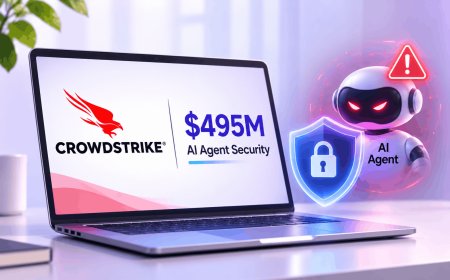
CrowdStrike is buying Fiddler AI and Dreadnode for about $495 million and adding an AI Kill Switch to rein in rogue AI agents.
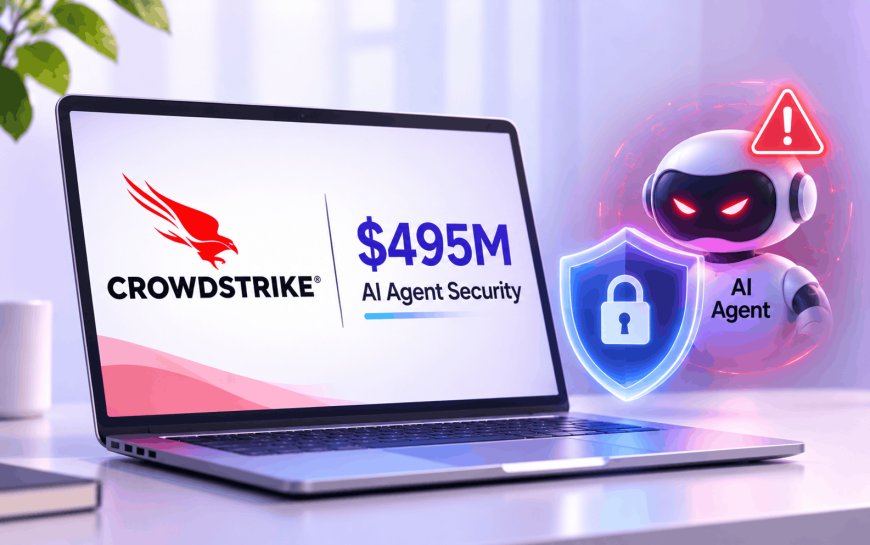
If an AI agent inside your company's network starts doing something it shouldn't, how exactly do you shut it off? CrowdStrike's answer this week was to build a literal kill switch — and to spend close to half a billion dollars making sure it has the technology to back it up.
What CrowdStrike Actually Bought
At its Fal.Con Europe conference on November 3, CrowdStrike announced agreements to acquire two AI security startups: Fiddler AI and Dreadnode. The deal hasn't been officially priced by the company, but multiple outlets covering the announcement put the combined figure at roughly $495 million — about $400 million for Fiddler and $95 million for Dreadnode, paid mostly in cash with a slice of stock tied to vesting conditions.
The two companies cover opposite ends of the same problem. Fiddler AI watches AI agents after they've been deployed, flagging when one starts behaving oddly, drifting from its intended behavior, or making decisions nobody can explain. Dreadnode does the opposite job earlier in the pipeline — it red-teams AI models and agents before they ship, deliberately trying to break or trick them the way an attacker would. Fiddler's tech is being folded into CrowdStrike's Falcon platform as "Falcon Observe," while Dreadnode becomes "Automated AI Security Testing." Dreadnode's team, led by CEO Brad Palm, is joining what CrowdStrike calls its Cyber Superintelligence Lab, with full integration expected by the fourth quarter of CrowdStrike's fiscal 2027.
The Kill Switch Nobody Asked For Until Now
Alongside the acquisitions, CrowdStrike introduced an "AI Kill Switch" inside Falcon Guardian, its existing AI security product. The pitch is blunt: when an autonomous agent starts taking actions a human didn't authorize — touching files it shouldn't, calling tools outside its scope, or looping on a bad decision — a security team needs one button that stops it cold, without having to hunt down which server or container the agent is running on.
An AI agent with real permissions and no off-switch isn't a productivity tool. It's an unpatched vulnerability that happens to be good at its job.
That framing matters because agentic AI — software that doesn't just answer questions but actually goes and does things, like filing tickets, moving money, or rewriting code — has moved from demo to production inside a lot of enterprises faster than the security tooling around it has matured.
A Pattern, Not a One-Off
This isn't the first big security vendor to bet on agent governance this year. Two months ago, Palo Alto Networks paid roughly $500 million for Console, a startup built to let AI agents triage and remediate security alerts on their own. CrowdStrike's move runs almost the opposite direction — instead of handing agents more autonomy, it's selling the tooling to watch, test, and restrain them. Put together, the two deals show the big cybersecurity vendors racing to own both sides of the same emerging market: agents that act, and the systems built to keep those agents in line.
- Fiddler AI — post-deployment monitoring, becomes Falcon Observe
- Dreadnode — pre-deployment red-teaming, becomes Automated AI Security Testing
- AI Kill Switch — a manual override built into Falcon Guardian
- Expected close and broader rollout — Q4 of CrowdStrike's fiscal 2027
Why This Matters for Indian Enterprises
India's IT services firms and the Global Capability Centres (GCCs) run out of Bengaluru, Hyderabad, and Pune have been among the most aggressive adopters of agentic AI anywhere, using it for everything from customer support triage to automating back-office finance workflows for global clients. Few of those deployments currently have anything like an audit trail or an emergency stop button built in — governance has lagged well behind rollout speed.
That gap lines up directly with what regulators are starting to ask for. Under India's Digital Personal Data Protection (DPDP) Act, a company remains accountable for how personal data is processed, even when the processing is done by an autonomous agent rather than a person clicking through a form. If an AI agent with database access makes an unauthorized change or leaks data while "doing its job," the company that deployed it carries the liability, not the software vendor. A verifiable way to monitor, test, and if necessary halt an agent isn't a nice-to-have for a GCC handling financial or health data under DPDP obligations — it's close to a baseline requirement, and tooling like this is what makes that baseline practically achievable rather than theoretical.
The Real Test Comes Later
None of this technology has been proven in a messy, real production environment yet — it's being announced and integrated, not battle-tested. The genuine test for Falcon Observe, Automated AI Security Testing, and the Kill Switch won't be a vendor demo. It'll be the first time an enterprise AI agent does something it wasn't supposed to at 2 a.m., and whether these tools catch it before anyone outside the security team even notices.
What's Your Reaction?
 Like
0
 Dislike
0
 Love
0
 Funny
0
 Angry
0
 Sad
0
 Wow
0