


























Nvidia Brings Back Jensen Huang as CEO, Stock Jumps 31%
Nvidia's board reinstated Jensen Huang as CEO days after ruling it out, sending shares up over 30% while its internal probe continues.
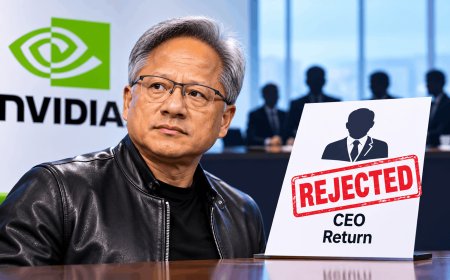
Eleven days ago, Nvidia's board said Jensen Huang was not coming back as CEO. On Monday, it reinstated him anyway — and the stock had its best day since 2003.
From resignation to reversal in under two weeks
Jensen Huang stepped down as Nvidia's president, CEO and board member on November 12, after the board said his personal conduct had fallen short of the company's own code of conduct. Reports from several outlets added that the fallout involved alleged relationships, including one with a woman later described as a Chinese intelligence operative — claims Nvidia itself never confirmed as the official reason. CFO Colette Kress stepped in as interim CEO, and the board brought in an executive search firm to look for a permanent replacement.
Five days later, board chair Harvey Jones seemed to close the door for good. On the company's earnings call, he told investors the board had "unanimously accepted" Huang's resignation and had no plans to bring him back, even though Huang had publicly said he would return if the board and shareholders wanted him to.
Then, on November 23, Nvidia filed a one-paragraph notice with U.S. regulators that undid all of it: the board had voted, again unanimously, to reinstate Huang as president, CEO and director, effective immediately. Jones was quoted calling Huang the right person to lead the company. Kress stays on as CFO and executive vice president, and the board thanked her for steering Nvidia through the gap.
Two boardroom statements, eleven days apart, saying the exact opposite thing — that is how fast a near-$5 trillion company's leadership question got settled and unsettled again.
What changed in between is still murky. Multiple reports say senior U.S. government officials, including pressure attributed to President Trump, pushed the board toward reversing course, given Nvidia's central role in America's AI chip strategy and its ongoing, sensitive negotiations over what hardware can be sold to China. Nvidia's own statement says the board's internal investigation into Huang's conduct is continuing and that he has agreed to cooperate with it — so this isn't a clean closure, just a decision to keep him in the chair while that process plays out.
Why the market reaction was so violent
Nvidia shares jumped more than 30% on the news, adding close to a trillion dollars in market value in a single session — a move traders compared to the company's biggest one-day gains in over two decades. That is a startling number for a company already among the most valuable on earth, and it says less about Huang as an individual than about how thin investors think Nvidia's bench is without him. He has been the public face of the AI boom's hardware side for years; a prolonged leadership vacuum at the one company every major AI lab depends on for chips was clearly priced as a real risk, and removing that risk was worth, in the market's eyes, roughly a trillion dollars.
- Nov 12: Huang resigns as CEO; Kress named interim CEO
- Nov 17: Board chair says reinstatement is off the table
- Nov 22: Nvidia halts H200 chip sales to China amid the leadership uncertainty
- Nov 23: Board reverses itself, reinstates Huang effective immediately; stock surges over 30%
Why this matters beyond Wall Street — including for India
This isn't just a Silicon Valley soap opera. Nvidia's GPUs (the specialised chips that do the heavy computing behind AI models) are the hardware backbone of India's own AI push, from the government's IndiaAI Mission to the GPU clusters that Reliance Jio, Tata Group, Yotta Data Services and several cloud providers have been racing to build with Nvidia's hardware and investment over the past year. Huang has visited India multiple times to announce these "AI factory" partnerships personally, and Indian firms building on that roadmap have a direct stake in whether Nvidia's leadership and supply commitments stay stable. A prolonged succession fight, or any sign that U.S.-China export politics could spill over into how India gets allocated chips, would have mattered a great deal to every Indian startup and enterprise currently renting or buying Nvidia compute.
There's also a simpler angle: a growing number of Indian retail investors now hold Nvidia indirectly through U.S.-focused mutual funds and Nasdaq-100 index funds sold by Indian asset managers. A single-day 30%-plus swing in Nvidia's stock shows up in those portfolios too, even for investors who have never traded a U.S. share directly.
As we covered when the board first ruled out Huang's return, the official explanation for his exit was always thinner than the rumours swirling around it. That gap between what Nvidia said and what multiple reporters uncovered hasn't closed with this reinstatement — if anything, reversing a "no" this firm, this fast, raises more questions about what the board's ongoing investigation will eventually make public.
What to watch next
The investigation Nvidia says is still underway is the real open thread here. A board can reinstate a CEO immediately; it can't un-ask the questions that made it push him out in the first place. Expect pressure from shareholders and probably from Congress — Huang was already summoned to testify over separate China-related chip questions this month — for Nvidia to eventually explain, in more than a single paragraph, what actually happened between November 12 and November 23.
What's Your Reaction?
 Like
0
 Dislike
0
 Love
0
 Funny
0
 Angry
0
 Sad
0
 Wow
0