









































Gemini 4 Argon Goes Live for All Developers, Pricing Revealed
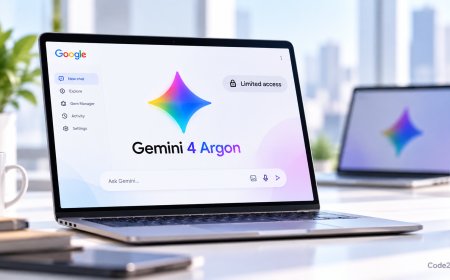
Google's Gemini 4 Argon is now generally available via API for every developer, but the launch pricing expires December 1.

Two weeks ago, getting your hands on Gemini 4 Argon meant being on a short list of testers and enterprise partners. That changed on October 13, when Google threw the model open to any developer with an API key through the Gemini API, Google AI Studio, and Vertex AI — no waitlist, no approval email.
From "most of us can't use it" to a public API key
The earlier rollout was deliberately narrow. Google staged access — first to select partners, then to AI Ultra subscribers — before letting ordinary developers near it. We covered that limited launch when it happened, and the complaint at the time was simple: a flagship model that almost nobody outside a lab could actually build with.
That gate is gone now, at least for anyone willing to pay. The free API tier is excluded, so this is a release aimed squarely at companies and serious builders, not hobbyists poking at it for fun. Google's own announcement frames it as a model "built to solve your hardest problems," with the headline upgrade being a jump in how much text it can output in a single response — up to 1 million tokens, compared to the 64,000-token ceiling on earlier Gemini models. In plain terms, a token is roughly three-quarters of a word, so that's the difference between generating a page of code and generating an entire codebase's worth of documentation in one pass.
The pricing clock is already running
Here's the part that matters more than the benchmarks: the pricing you see today isn't the pricing you'll pay in eight weeks. Through November 30, Gemini 4 Argon costs $2 per million input tokens and $10 per million output tokens, with cached input (text the model has already processed once) discounted by 95%. From December 1, both rates double — to $4 and $20 per million tokens.
- Standard API (through Nov 30): $2 input / $10 output per million tokens
- Standard API (from Dec 1): $4 input / $20 output per million tokens
- Batch and Flex tiers: roughly half the standard rate during the introductory window
- Cached input: 95% cheaper than fresh input tokens
There's also a genuine access wrinkle worth flagging: it's unclear whether AI Pro subscribers using the consumer Gemini app get Argon at all — some reporting says only Pro and Ultra tiers do, while Google's own pricing page reportedly shows no free-tier access whatsoever. If you're planning to build a product around this model, that's worth confirming directly on Google's pricing page before you commit, rather than assuming either way.
An introductory price that doubles on a fixed date isn't a discount — it's a trial period with a bill waiting at the end of it.
What this means if you're building from India
India has one of the largest developer bases on Google AI Studio, and a lot of that activity is from bootstrapped startups and freelance builders where a few cents per million tokens is a real line item, not rounding error. A founder prototyping on Argon this month at $2/$10 pricing needs to model what the same usage costs at $4/$20 from December — for an India-based SaaS team charging in rupees with thin margins, that's not a hypothetical, it's a budget line that doubles overnight unless you've planned for it.
There's also a compliance angle that Indian teams specifically need to think about. Any startup routing customer data through the Gemini API — especially in regulated areas like fintech or health-tech — has to check where that data is processed and whether it satisfies the data-handling expectations under India's Digital Personal Data Protection (DPDP) Act — the law that governs how personal data about Indian users can be collected, stored, and moved — since cross-border processing of that data is exactly the kind of thing the Act's rules will eventually bite on. Google has previously rolled out onshore processing options for some Gemini models aimed at exactly this kind of regulated use case in India; it's worth checking whether Argon gets the same treatment before wiring it into anything that touches customer data.
Why the output limit matters more than it sounds
A 1-million-token output ceiling sounds like a spec-sheet number until you picture what it actually unlocks: generating an entire technical document, a large batch of translated content, or a sprawling codebase refactor in one API call instead of stitching together dozens of smaller requests. That's less exciting for a chatbot and a lot more useful for the kind of bulk, automated work Indian IT services and product teams actually do at scale — document processing, code migration, large-scale content localization.
The real question isn't whether it's good
Every early benchmark comparison says Argon is a capable model — that was never really in doubt for a flagship Gemini release. The more useful question for anyone deciding whether to build on it now is a financial one: are you locking in a workflow around a price that's guaranteed to double in under two months? Teams that move fast to prototype on the cheap window and then quietly recalculate their unit economics before December 1 will be in a far better spot than the ones who get surprised by the invoice.
What's Your Reaction?
 Like
0
Like
0
 Dislike
0
Dislike
0
 Love
0
Love
0
 Funny
0
Funny
0
 Angry
0
Angry
0
 Sad
0
Sad
0
 Wow
0
Wow
0