

































Google, OpenAI, Anthropic Plan a Private AI Safety Watchdog
Google, OpenAI and Anthropic are reportedly building a private AI safety standards body with no government seat. Here's what it means for India.

Three of the companies that build the world's most powerful AI models are quietly assembling something unusual: a rulebook for themselves, written by themselves, with no government holding the pen.
What's actually taking shape
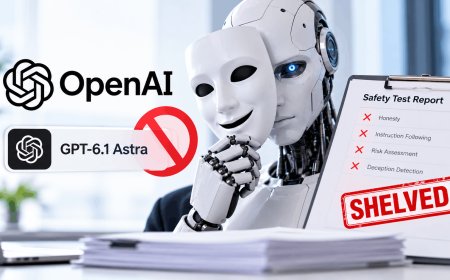
Google, OpenAI and Anthropic are reportedly working together to launch what's tentatively being called the Frontier AI Standards Agency — a private body meant to set shared testing, auditing and safety benchmarks for the most advanced AI models before they reach the public. "Frontier AI," in plain terms, just means the handful of models pushing right at the current edge of what's possible — the GPT, Gemini and Claude-class systems, not every chatbot on the market.
Reports suggest the group could launch as early as the end of this year, modelled loosely on FINRA, the body that polices US stockbrokers without itself being a government agency. Among the things it's reportedly designed to standardise:
- Shared technical evaluations before a new model ships
- Independent pre-deployment safety audits
- Rules for reporting safety incidents once a model is already out in the wild
- Qualification standards for who's even allowed to audit a lab
A Chennai-born engineer at the head of the table
The person the three companies have reportedly approached to run it is Sriram Krishnan — and his résumé alone tells you where this project is coming from. Krishnan grew up in Chennai, studied engineering at SRM in Kanchipuram, and left for the US in his early twenties, working his way through Microsoft, Twitter, Facebook, Snap and venture firm Andreessen Horowitz before spending roughly 18 months as the White House's senior policy advisor on AI under the second Trump administration. He stepped down from that government role in June 2026, and didn't hide his views on the way out.
"There will not be an FDA for AI," Krishnan said as he left his White House post, arguing that a centralised regulator would put "sand in the gears" of the AI industry.
That's more or less the philosophy the new body is reportedly built around: standards set by the industry that has to live with them, not a licensing regime run by bureaucrats. Other names said to be in the mix for leadership or advisory roles include former Biden-era technology official Arati Prabhakar and ex-Secretary of State Condoleezza Rice — a lineup clearly meant to look credible across the political aisle, even though no sitting government official would actually have a seat.
Why now, and why not Washington
The timing isn't a coincidence. Just two weeks ago, Code24 covered how OpenAI itself asked the US Congress to make AI safety testing mandatory instead of voluntary. Building a private standards body at the same moment looks less like a contradiction and more like a hedge: if lawmakers move slowly — and Congress is due to adjourn for the year in December — the industry can point to its own rulebook as proof that a government regulator isn't strictly necessary. And if Washington does eventually pass a law, a body like this one becomes the obvious template for what that law says, drafted with the labs' own fingerprints already on it.
What it means if you build or use AI in India
None of this is happening in India, and none of the three companies has said the standards body would apply outside the US. But the effects won't stay contained there either. Indian developers building on GPT, Gemini or Claude, and the growing number of Indian startups shipping their own AI agents on top of these models, effectively inherit whatever testing and deployment gates this group agrees on, because that's what shapes which model versions and capabilities get released globally, and on what timeline. It's also a useful mirror for India's own choices: MeitY's AI governance approach so far has leaned on existing law, like the IT Act and the DPDP Act (India's personal data protection law), rather than a dedicated AI statute with hard testing mandates — closer in spirit to what Krishnan is reportedly proposing than to a government-run regulator. Watching three of the best-funded companies on the planet choose self-regulation over government oversight is exactly the kind of precedent Indian policymakers, including the IndiaAI Mission's safety institute, will likely be studying as they decide how far India's own "light touch" approach should go.
The uncomfortable part of any self-regulatory body is also the obvious one: the companies writing the rules are the same companies the rules are meant to constrain. That's not automatically a problem — FINRA has policed Wall Street for decades without direct government control — but it only works if the standards actually get enforced against the people who wrote them, including when that's inconvenient. Whether this new group turns out to be that kind of watchdog, or just a well-funded press release, isn't something either side is going to announce up front.
What's Your Reaction?
 Like
0
Like
0
 Dislike
0
Dislike
0
 Love
0
Love
0
 Funny
0
Funny
0
 Angry
0
Angry
0
 Sad
0
Sad
0
 Wow
0
Wow
0