








































What Is Docker? Containers vs Virtual Machines Explained
Docker explained in plain English: what containers are, how they differ from VMs, and why they matter for Indian dev teams.

Ask five developers what Docker actually does and you'll probably get five different half-answers. "It's like a lightweight VM." "It packages your app." "It's how you deploy stuff." All half-true, none of it quite clicks until you've watched a coworker say "works on my machine" and then watched that exact bug disappear the moment the app runs in a container instead.
That's really the whole pitch. Docker doesn't make your code faster or your servers cheaper by itself — it makes the environment your code runs in portable, so the version that works on your laptop is bit-for-bit the same version that runs in production, on a teammate's machine, or on a server in a data centre you'll never see.
Containers vs virtual machines: the distinction everyone gets wrong
Before Docker became popular, the standard way to isolate an application was a virtual machine (VM) — software that pretends to be an entire separate computer, complete with its own operating system, kernel, and virtual hardware. A VM is heavy: it can take gigabytes of disk space and a minute or more to boot, because it's essentially simulating a whole PC from scratch.
A container is a much thinner slice. Instead of simulating an entire computer, it shares the host machine's operating system kernel (the core program that talks to the actual hardware) and only isolates the application, its libraries, and its configuration files. That's why a container typically starts in under a second and takes megabytes, not gigabytes.
Think of a VM as building a separate house for every guest. A container is more like giving each guest their own locked room in the same house — faster to set up, and you're not duplicating the plumbing.
This matters in practice: on a single physical server, you might comfortably run a dozen containers where you'd struggle to fit more than two or three full VMs.
What actually happens when you "dockerize" an app
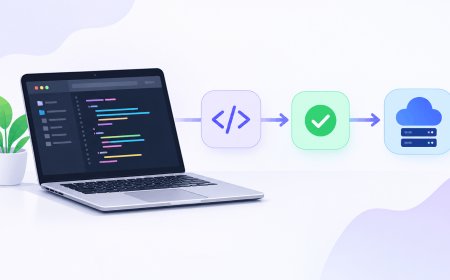
The workflow, stripped down, looks like this:
- Write a Dockerfile — a plain text file listing the exact steps to set up your app's environment: which base operating system to start from, which packages to install, which files to copy in, and what command to run when it starts.
- Build an image — Docker reads that Dockerfile and produces an "image," a frozen, reusable snapshot of everything your app needs to run.
- Run a container — you start that image, and Docker spins up an isolated, running instance of it. You can start as many containers from one image as you want, each isolated from the others.
- Push and pull — images get uploaded to a registry (Docker Hub is the most common one, roughly the GitHub of container images) so anyone on the team, or any server, can pull down the exact same image and run it identically.
That last point is the real magic. There's no "install these seventeen dependencies in this exact order" README anymore. There's just docker run.
Why this matters more in India than the marketing decks let on
India's developer ecosystem has grown up largely cloud-first and startup-heavy, and containers fit that reality well. A huge share of the country's early-stage startups run on tight infrastructure budgets, and being able to pack more services onto fewer, cheaper servers — because containers use resources so much more efficiently than VMs — has a direct effect on the cloud bill, whether that's on a domestic provider or AWS's Mumbai region.
It also solves a very specific, very common pain point in Indian dev teams: a lot of engineering is distributed across freelancers, agencies, and offshore teams working on different laptops, different Windows/Linux/Mac setups, sometimes different internet speeds entirely. Docker collapses "did you install the right Node version" into a non-issue, because the container carries its own environment with it regardless of what's on the host machine. For students and self-taught developers building portfolios for the job market — a genuinely large and growing group in India — knowing Docker is close to a baseline expectation on job listings now, not a bonus skill.
Where Docker actually falls short
It's not a free lunch. A few things worth knowing before you commit to it:
- Containers share the host's kernel, which means the isolation is weaker than a full VM's — a serious enough kernel-level bug can, in rare cases, let a process inside a container affect the host. Code24 covered a real instance of exactly this in a recent piece on a Linux kernel flaw that let attackers escape containers.
- Persisting data (like a database) inside containers takes extra care — containers are meant to be disposable, so anything you don't explicitly save outside the container disappears when it's removed.
- Running one container is simple; running fifty of them in production, with networking, scaling, and failover between them, is a genuinely hard problem — which is why an entire separate tool, Kubernetes, exists just to manage fleets of containers.
None of that makes Docker a bad choice — it just means "containers are simple" only holds true for the first project, not necessarily the fiftieth.
Should you actually learn it?
If you're a backend developer, a DevOps-adjacent engineer, or anyone shipping code that needs to run somewhere other than your own laptop, yes — it's become close to table stakes rather than a specialty skill. If you're purely doing frontend work with no deployment responsibilities, it's less urgent, though even there, knowing enough Docker to spin up a local database or a test environment saves real time.
The good news is the learning curve for basic use is genuinely short — a working Dockerfile for a simple app is often under fifteen lines. The depth comes later, if and when you need it, in orchestration and production hardening. Start small: containerize one side project this week, and the concept stops being abstract fast.
What's Your Reaction?
 Like
0
Like
0
 Dislike
0
Dislike
0
 Love
0
Love
0
 Funny
0
Funny
0
 Angry
0
Angry
0
 Sad
0
Sad
0
 Wow
0
Wow
0