
































AMD Acquires Fei-Fei Li's World Labs for $8.2 Billion
AMD is paying $8.2 billion in stock for Fei-Fei Li's World Labs, betting spatial AI will shape its next generation of chips.

AMD just wrote its second-biggest check ever, and this one isn't for a factory or a stockpile of chip capacity. It's for a startup that teaches software to understand rooms, streets and warehouses the way a human walking through them would.
The chipmaker announced it is buying World Labs, the AI startup founded by Stanford professor Fei-Fei Li, for $8.2 billion in an all-stock deal — meaning AMD is paying in its own shares rather than cash. The transaction is expected to close by the end of the year, pending regulatory approval, and it's the largest acquisition AMD has made since its roughly $50 billion purchase of Xilinx in 2022.
What AMD actually bought
World Labs isn't a chatbot company. It builds what researchers call "world models" — AI systems that can generate, reconstruct and simulate interactive 3D environments from a text prompt, a photo or a video clip. The same technology underpins work on robotic learning and simulation, letting a robot or an autonomous vehicle practice navigating a space before it ever encounters it for real.
Li, often called the "godmother of AI" for her role building ImageNet, the dataset that kickstarted the deep-learning boom over a decade ago, will join AMD as executive vice president and chief scientist, reporting directly to chief executive Lisa Su.
Why chipmakers suddenly care about "physical AI"
Large language models learned to write and reason mostly by reading text. The next frontier — often called physical AI or spatial AI — is about machines that perceive and move through the real world: warehouse robots, delivery drones, factory arms, self-driving cars. That requires a completely different kind of chip, one built to process depth, motion and 3D geometry in real time rather than just crunching text tokens.
That's the bet AMD is making. Lisa Su said the company needs "a deep understanding of how models are evolving" to design the compute platforms those models will eventually run on — in other words, AMD wants World Labs' research to shape its chip roadmap years before those chips ship. It's a similar instinct to the one that pushed AMD past the trillion-dollar valuation mark earlier this month: stay ahead of where AI demand is heading, not just where it is today.
Where this lands for India
This deal isn't just a Silicon Valley story. AMD's largest chip design centre anywhere in the world is in Bengaluru — a roughly 3,000-engineer campus built on a $400 million investment — and India as a whole accounts for close to a quarter of AMD's global workforce, spread across Bengaluru, Hyderabad, Delhi, Gurgaon and Mumbai. Whatever chip requirements come out of World Labs' research on robotics and spatial AI will, in practice, run through design work happening in those Indian offices.
There's a broader angle too. India has been pushing hard on both its domestic semiconductor design ecosystem and, separately, on robotics and autonomous-systems research tied to manufacturing and logistics. A major chipmaker folding a physical-AI lab into its core roadmap is a signal of where global R&D dollars — and eventually, engineering jobs — are headed. For Indian AI and robotics talent, it's one more reason spatial AI is worth watching closely, not just language models.
"Now that we have tangible proof of the possibilities, we want to do everything we can to accelerate the future. To do this requires scaling our efforts, widening our reach, and getting closer to the hardware." — Fei-Fei Li, founder, World Labs
A few numbers that put the deal in context:
- $8.2 billion — the all-stock price AMD is paying, its second-largest acquisition on record
- 2022 — the last time AMD spent this big, on its ~$50 billion Xilinx deal
- 3,000+ — engineers at AMD's Bengaluru design campus, its biggest globally
- ~25% — share of AMD's worldwide workforce currently based in India
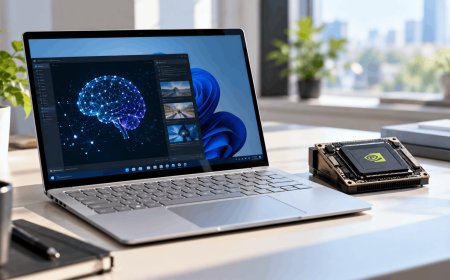
Nvidia has spent the last two years building an early lead in robotics and simulation tooling for physical AI. This deal is AMD's clearest signal yet that it doesn't intend to cede that ground — and it's betting that the next fight in AI chips won't be about who writes the best chatbot, but who best teaches a machine to understand the space around it.
What's Your Reaction?
 Like
0
Like
0
 Dislike
0
Dislike
0
 Love
0
Love
0
 Funny
0
Funny
0
 Angry
0
Angry
0
 Sad
0
Sad
0
 Wow
0
Wow
0