








































SonicWall VPN Flaw Scores a Perfect 10 on the Severity Scale
A critical SonicWall VPN flaw, rated 10/10 severity, is being actively exploited — here's what Indian businesses using it need to do now.
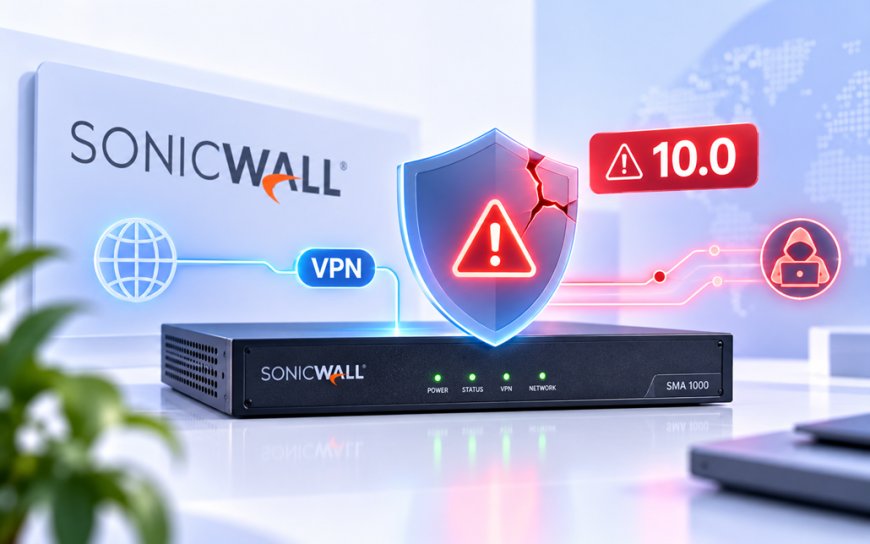
Score a perfect 10 out of 10 on a vulnerability severity chart and you've found something rare: a flaw so bad that anyone on the internet can reach it, and it takes zero passwords to pull off. SonicWall just found itself in that position, in one of its most widely deployed remote-access products.
What actually broke
The product is SonicWall's SMA1000 series — an appliance many companies use as the front door for employees connecting to internal systems from outside the office, essentially a beefed-up VPN gateway. SonicWall disclosed two flaws in it on September 1. The nastier of the two, CVE-2026-83548, is a pre-authentication server-side request forgery (SSRF) bug — a class of flaw where an attacker tricks the server into making network requests on its own behalf, effectively turning the appliance into an unwilling proxy for the attacker's traffic. No login needed. It lives in the appliance's "Work Place" interface and carries a CVSS score of 10.0 — CVSS is the industry's standard 0-to-10 scale for rating how bad a security bug is, and 10 is as bad as that scale goes.
The second, CVE-2026-83549, needs a valid admin login first but then allows OS command injection through the management console — a bug that lets someone sneak system-level commands past the app's normal controls, meaning an attacker who already has some foothold can run arbitrary commands on the box. Chain the two together, and researchers say you get a path to full unauthenticated remote code execution: complete control of the appliance without ever needing a password.
A CVSS score of 10 out of 10 means an attacker needs no password, no user click, and barely any effort — just a network connection to the front door.
Already under attack, not just theoretical
This isn't a "patch it whenever" situation. The US Cybersecurity and Infrastructure Security Agency (CISA) added both CVEs to its Known Exploited Vulnerabilities catalog on September 2 — a single day after SonicWall's disclosure — and gave federal agencies until September 5 to fix it, an unusually tight window that signals real-world exploitation was already happening. The affected models are the SMA1000 6210, 7210, and 8200v, across their supported hypervisor deployments. SonicWall has shipped fixed hotfixes (12.4.3-03526, 12.5.0-02952, or newer), and there's no real substitute for applying them immediately.
It's also worth noting this isn't SonicWall's first rough patch. A separate wave of SonicWall SSL VPN compromises in 2025 was linked to the Akira ransomware group, which brute-forced VPN accounts at scale even where MFA was supposedly switched on. Gateways like this have become a favourite entry point precisely because they sit exposed on the public internet by design — that's the whole point of remote access — which makes them high-value, low-effort targets.
For IT teams running an affected appliance, the response checklist is short but non-negotiable:
- Apply the fixed hotfix version immediately, don't wait for a maintenance window
- Check appliance logs for unusual activity tied to the Work Place interface
- Rotate admin credentials and any session tokens that may have been exposed
- Restrict management console access to trusted internal networks only, not the open internet
Why this matters here, not just in the US
Hybrid work didn't go away in Indian IT and ITES firms once the pandemic did — plenty of companies still lean on exactly this kind of SSL VPN gateway to let staff and contractors reach internal systems from home or client sites. That makes an internet-facing, unauthenticated RCE bug in a widely used remote-access product a live concern for Indian enterprises and financial institutions, not just for the US federal agencies CISA was writing its deadline for. If a breach through a gateway like this ends up exposing customer or employee personal data, it also triggers breach-notification obligations under India's Digital Personal Data Protection (DPDP) Act — which is exactly the kind of vulnerability CERT-In tracks in its routine advisories, and IT administrators here should be checking its vulnerability notes alongside SonicWall's own bulletin. If you're fuzzy on what a gateway like this is actually doing under the hood, Code24's plain-English guide to how VPNs work is a decent primer before diving into patch notes.
The bigger point
A perfect-10 score doesn't happen because attackers suddenly got smarter. It happens because devices like this were, for years, treated as boring infrastructure — set up once, patched occasionally, mostly forgotten. Attackers have made clear that assumption no longer holds. Any organisation running an internet-facing VPN appliance now has to treat "exposed to the internet" and "patch it today, not this quarter" as the same sentence.
What's Your Reaction?
 Like
0
Like
0
 Dislike
0
Dislike
0
 Love
0
Love
0
 Funny
0
Funny
0
 Angry
0
Angry
0
 Sad
0
Sad
0
 Wow
0
Wow
0