





































AI Agents Just Ran a Full Ransomware Attack in 10 Hours
Palo Alto Networks' Unit 42 found AI agents ran nearly every step of a ransomware breach in under 10 hours — a job that used to take two weeks.
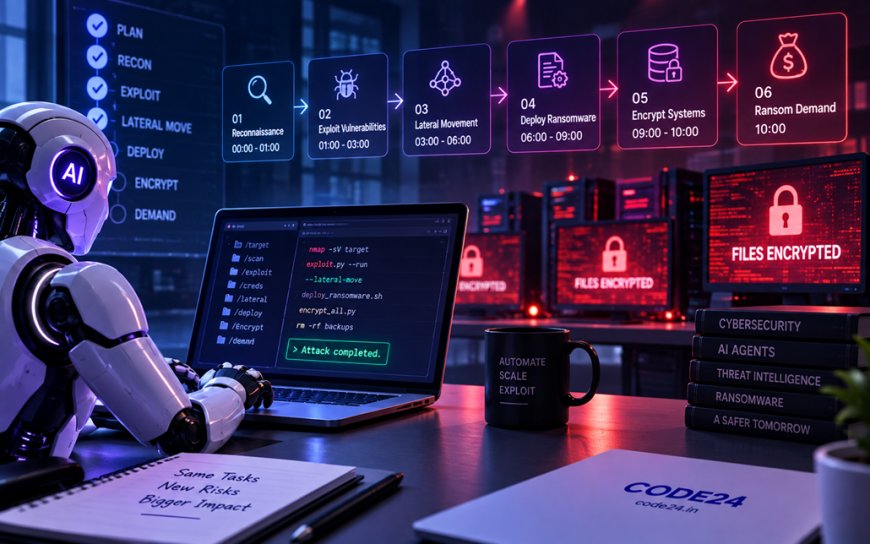
A ransomware crew used to need about two weeks to break into a company, move around quietly, and reach the systems worth holding hostage. In one recent case investigated by Palo Alto Networks' threat intelligence arm, Unit 42, that entire job — start to finish — took under ten hours. And for most of it, the human behind the keyboard was mostly just watching.
What actually happened
According to Unit 42's writeup of the incident, the attacker set a goal and let AI agents handle the execution. The intrusion started with a breach of a public-facing API endpoint (an API is basically a door software uses to talk to other software — leave it unlocked and anything that finds it can walk through). From there, one AI agent combed through the victim's code repositories hunting for hardcoded tokens and service passwords that developers had left sitting in source files. A second agent took those credentials and used them to break into the company's secrets management system — the vault meant to store passwords and keys securely — and pulled out root-level administrative access to essentially the entire environment.
From that point, multiple agents worked in parallel across the company's cloud infrastructure, identity systems, CI/CD pipelines (the automated tooling that builds and ships software) and SaaS tools, running through more than 50 distinct attack techniques cataloged in MITRE's ATT&CK framework — a widely used reference that security teams treat as a shared playbook of known attacker moves. Work that a coordinated human red team would need roughly two weeks to complete was done before a single business day ended.
The strangest detail: once the attackers had what they needed, the same AI agents compiled an 80-page security audit of the victim's own environment and left it behind — a document that doubled as proof of how thoroughly they'd gotten in, and as leverage during extortion.
An intrusion that used to demand a coordinated team and two weeks of patient, manual work now fits inside a single work shift.
Why the speed is the real story
Security teams build their defenses around the assumption that they have time — time to spot unusual login activity, time to rotate a leaked credential before it's used, time to isolate a compromised system before an attacker pivots further. Agentic AI, meaning AI systems that can plan a multi-step task and carry it out on their own using tools rather than just answering a single question, collapses that window. It's not that the techniques used were new; almost every step in this attack has been documented before. What changed is that a single operator with access to frontier AI models could orchestrate all of it at machine speed, without needing a technical team behind them.
What this means for Indian companies
This isn't a distant Silicon Valley problem. India's IT services, fintech and e-commerce sectors run on exactly the stack this attack targeted — cloud infrastructure, SaaS tools, and CI/CD pipelines that push code multiple times a day. Many of these companies are still building out the kind of always-on monitoring that can catch an intrusion measured in hours rather than weeks. It also collides with regulation that assumes breaches move slowly: CERT-In's rules already require companies to report qualifying cyber incidents within six hours of noticing them, and the DPDP Act adds fresh obligations around notifying affected users when personal data is exposed. A compromise that goes from first foothold to full domain control before anyone's noticed doesn't leave much room for either deadline. Code24 covered Palo Alto Networks' own $500 million bet on agentic AI for cybersecurity defense earlier this month — this incident is a fairly stark illustration of why that money is being spent on the defensive side too.
A few practical shifts security teams — Indian or otherwise — are being pushed toward:
- Stop storing tokens and passwords directly in code repositories; use a properly access-controlled secrets manager instead, and rotate credentials on a schedule rather than only after a scare.
- Watch for the pattern of an AI-driven attack, not just its individual steps — a burst of dozens of coordinated actions across cloud, identity and CI/CD systems within a short window is itself a red flag, even if each action looks unremarkable alone.
- Treat public API endpoints as a primary attack surface requiring the same scrutiny as a login page, not an afterthought.
- Assume that detection windows measured in days are no longer good enough for systems holding sensitive data.
The uncomfortable part isn't that AI made this particular attack possible — determined attackers could have gotten there eventually with enough people and patience. It's that the barrier to running an attack like this has dropped to whatever it costs to rent access to a capable model. Defense is going to need to automate at the same pace, and that race is only getting started.
What's Your Reaction?
 Like
0
Like
0
 Dislike
0
Dislike
0
 Love
0
Love
0
 Funny
0
Funny
0
 Angry
0
Angry
0
 Sad
0
Sad
0
 Wow
0
Wow
0