





























China's Kimi K3 AI Model Could Come to Azure, AWS and Google Cloud
Moonshot AI is reportedly in talks with Microsoft, Amazon and Google to host its Kimi K3 model on their clouds for up to a 30% revenue cut.
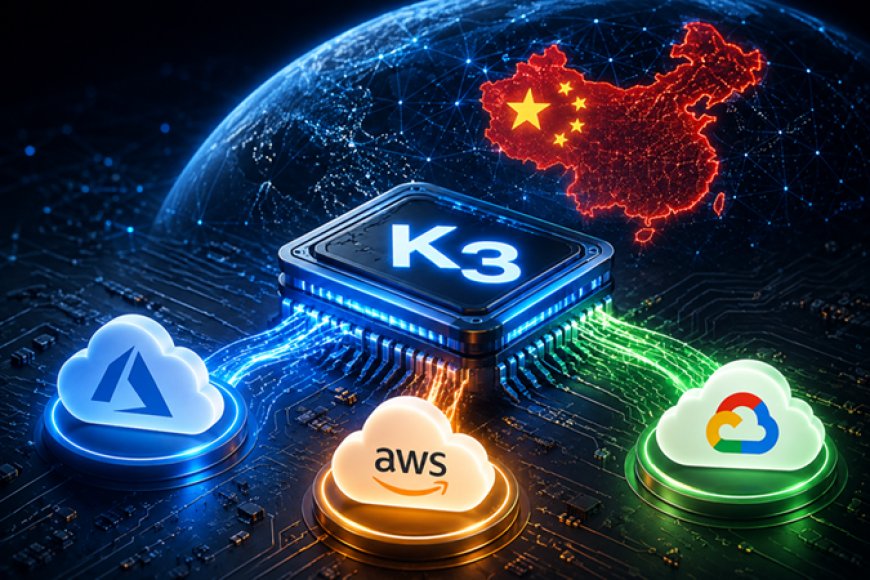
Microsoft, Amazon and Google spent the last three years trying to keep Chinese AI labs off their clouds, not invite them in. Now all three are reportedly negotiating to do exactly that, for a Beijing-based startup most people outside AI circles have never heard of.
What's actually on the table
Moonshot AI, the company behind the Kimi family of models, is said to be in early talks with Microsoft Azure, Amazon Web Services and Google Cloud to host its latest release, Kimi K3, directly on their platforms. In exchange, Moonshot is asking for a cut of whatever revenue the model generates on each cloud, reportedly as much as 30 percent.
Nothing is signed yet. People familiar with the discussions say several basic questions are still unresolved: how the revenue actually gets split, what access Moonshot would get to usage data, and how the two sides would even agree on how much the model was used in the first place — a process usually called auditing "token" usage, tokens being the small chunks of text an AI model reads and generates, which is how most AI billing works. Moonshot has reportedly already struck similar, smaller arrangements with less prominent cloud providers, so this would be a scaled-up version of something it's already tested.
Why a cloud giant would even consider this
Kimi K3 isn't a token gesture. It's an open-weight model — meaning Moonshot publishes the actual model files for anyone to download, inspect or fine-tune, unlike closed systems where you only ever get access through an API — built on roughly 2.8 trillion parameters. Independent benchmarking outfit Artificial Analysis has reportedly placed its performance on complex, multi-step reasoning tasks in the same range as OpenAI's GPT-5.5 and Anthropic's Claude Opus 4.8, which is precisely why Microsoft, Amazon and Google might tolerate the awkwardness of paying a Chinese lab rather than simply blocking it.
Running a 2.8-trillion-parameter model yourself is not realistic for almost anyone outside a handful of well-funded labs — the compute costs alone put it out of reach. That's exactly the gap a cloud-hosted version fills: any enterprise with an Azure, AWS or Google Cloud account could plausibly call Kimi K3 the same way they call GPT-5.5 today, without owning a single GPU.
A frontier-scale Chinese model, one API call away, sitting on the exact same cloud infrastructure Indian companies already run their production systems on — that's a genuinely new situation, not an incremental one.
Where this gets complicated for Indian users
This matters well beyond Silicon Valley. Azure, AWS and Google Cloud are already the default backbone for a huge share of Indian AI startups, fintechs and enterprise IT teams — many of whom chose these platforms partly for the compliance tooling and data-residency options they offer under India's Digital Personal Data Protection (DPDP) Act. If Kimi K3 shows up as just another model option inside that same familiar console, Indian teams get access to GPT-5.5-class capability without the usual pricing that OpenAI and Anthropic command — a real lever for startups watching their inference bills closely.
But it's not a free lunch. India has been unusually willing to act against Chinese digital products on national-security grounds — the 2020 ban on dozens of Chinese apps is the obvious precedent — and the Ministry of Electronics and IT has kept a wary eye on Chinese AI tools since. A revenue-sharing deal that gives Moonshot visibility into how its model is used, even indirectly through token-usage audits, is likely to draw exactly that kind of scrutiny if Indian enterprises start routing meaningful workloads through it. Expect procurement teams at banks and government-adjacent companies to ask hard questions before flipping the switch, regardless of how good the benchmarks look.
What to watch next
- Whether Microsoft, Amazon and Google actually finalize terms, or whether the unresolved data-access questions kill the deal quietly, as happens with most "in early talks" stories.
- Whether the eventual revenue split lands anywhere near the 30 percent Moonshot is said to be seeking, since that number alone will shape whether other Chinese labs try to copy this playbook.
- Whether Indian cloud customers get access to Kimi K3 on the same terms as US customers, or whether it ships as a US/EU-only offering first.
If this goes through, it won't just be a story about one model landing on three clouds. It'll be the first real test of whether a major US cloud provider can commercially host a frontier Chinese AI model without the arrangement itself becoming the next flashpoint in AI's geopolitics — and Indian enterprises, sitting on those same clouds, will be watching from a front-row seat they didn't ask for.
What's Your Reaction?
 Like
0
Like
0
 Dislike
0
Dislike
0
 Love
0
Love
0
 Funny
0
Funny
0
 Angry
0
Angry
0
 Sad
0
Sad
0
 Wow
0
Wow
0