










































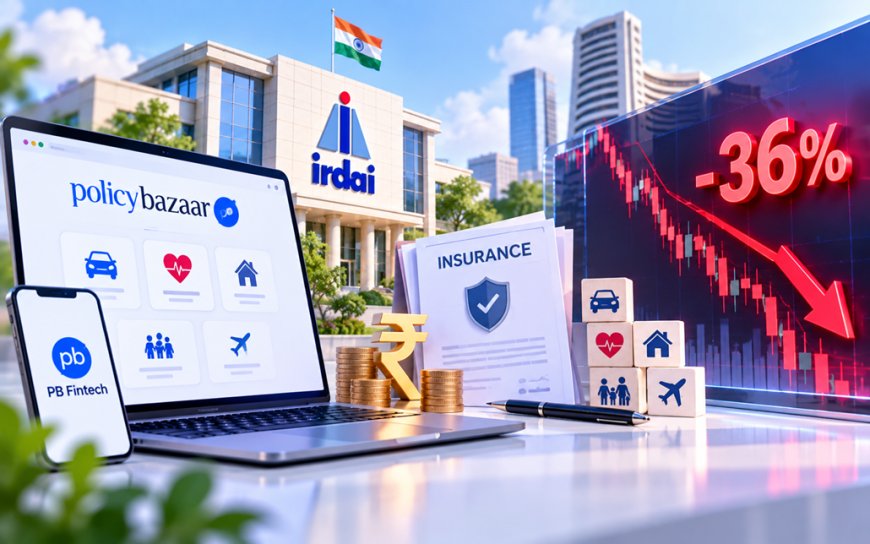
PB Fintech Crashes 36% as IRDAI Moves to Cap Insurance Commissions
IRDAI's plan to cap insurance commissions wiped out ₹31,000 crore from PB Fintech's market value in a single trading day.
Policybazaar's parent company just had its worst day on the stock market since it went public in 2021 — and the cause wasn't a hack, a lawsuit, or a bad quarter. It was a 62-page consultation paper from India's insurance regulator.
A ₹31,000 Crore Reality Check
On September 24, shares of PB Fintech — the listed company behind Policybazaar — fell 36% in a single session, closing at ₹1,207.20 and wiping out more than ₹31,000 crore (roughly $3 billion) in market value. Turtlemint, a smaller rival that runs a similar model of selling insurance online through agents, hit its 20% lower circuit and stayed pinned there all day. A "lower circuit" is simply the maximum drop a stock exchange allows in one session before trading in that stock is paused — Turtlemint hit that floor almost immediately.
The trigger was a paper released a day earlier by the Insurance Regulatory and Development Authority of India (IRDAI) — the government body that decides how insurers can sell policies and how much they can spend doing it — titled "Recalibrating Economics of Insurance Distribution."
What IRDAI Is Actually Proposing
At the center of the paper is a squeeze on what insurers call "expenses of management," or EoM — the overall budget an insurer is allowed to spend on running its business and selling policies, which includes the commissions paid to agents, banks, and online platforms like Policybazaar. IRDAI wants to bring that budget down sharply and put a hard, company-level ceiling on it:
- Life insurers: EoM capped at 15% of gross direct premium within two years, tightening further to 12.5% within five years.
- General insurers: EoM cut from 30% of gross written premium down to 20% of domestic gross direct premium over five years.
- Specific commission categories would fall even harder — for instance, credit life commissions could drop from around 28% to 2%, and health insurance commissions from roughly 40% to 5%, according to a note from Axis Securities.
Some analysts estimate commissions in a handful of high-margin categories could compress by 70-90% if the draft goes through as written. Nothing changes tomorrow, though — IRDAI is taking public comments until October 25, and the deepest cuts are spread across a five-year glide path, industry shorthand for a gradual, staged rollout rather than an overnight rule change.
Why Policybazaar Took the Biggest Hit
Traditional insurance agents earn a living in more than one way, but digital aggregators like Policybazaar and Turtlemint lean heavily on upfront commissions from insurers every time they sell a policy through their app or website. Squeeze that commission and you squeeze the core of their revenue model directly, which is exactly why the market reaction was so lopsided compared to, say, LIC or SBI Life, whose in-house agency networks and cost structures give them more room to absorb the change.
"The proposed commission cuts are far more severe than expected." — Bernstein analysts, reacting to IRDAI's draft
Axis Securities analysts called the draft a "material reset" of insurance distribution economics in India, which is about as blunt as a brokerage note gets. It's worth noting IRDAI's stated goal isn't to punish aggregators — the paper frames this as an anti-misselling measure, aimed at insurers who push expensive add-ons or high-commission products on customers instead of what actually suits them.
What It Means If You're in India
This isn't a story happening somewhere else that India should watch from a distance — it's happening to an Indian regulator, an Indian public company, and Indian retail investors, plenty of whom hold PB Fintech in their portfolios after its listing became something of a bellwether for the country's startup IPO wave. If you're one of them, the next month matters: comments close October 25, and how much IRDAI softens the draft in response to industry pushback will decide whether Thursday's crash was a one-off shock or the start of a longer repricing.
For everyday buyers, the intent, at least on paper, points toward less aggressive selling and more transparent pricing over time, since agents and platforms will have less financial incentive to steer you toward the policy that pays them the most. For India's broader insurtech and fintech scene, it's a reminder that a single regulatory paper can erase years of stock market gains overnight — a risk that's easy to underweight when a business model depends this heavily on rules a ministry can rewrite.
The five-year glide path buys everyone time to adjust, but it doesn't buy certainty. Distribution platforms built on today's commission structure now have a countdown clock, and how they redesign their business before it runs out will say a lot about whether India's insurtech boom was built on genuine efficiency or just on fees regulators eventually decided were too generous.
What's Your Reaction?
 Like
0
Like
0
 Dislike
0
Dislike
0
 Love
0
Love
0
 Funny
0
Funny
0
 Angry
0
Angry
0
 Sad
0
Sad
0
 Wow
0
Wow
0