





















DeepSeek's New Model Cuts AI Agent Memory Costs by 75%
DeepSeek's V4.1-Flash model slashes the memory AI agents need by up to 80%, cutting costs sharply — good news for cash-strapped Indian AI startups.
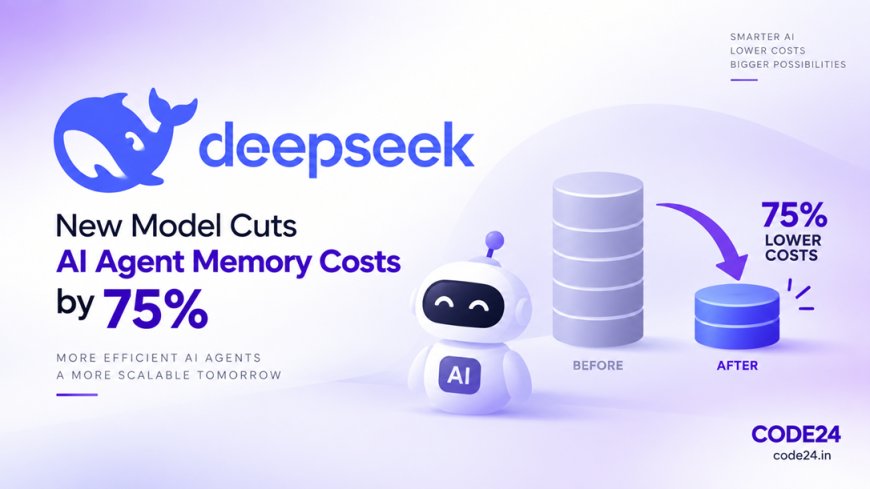
Ask an AI agent to spend an afternoon combing through a codebase, a legal contract, or a stack of customer tickets, and somewhere behind the scenes a server is quietly burning through gigabytes of memory just to remember what it already told itself ten minutes ago. DeepSeek's newest model release makes that problem roughly four times cheaper to live with — and it's landing at exactly the moment cost, not raw intelligence, has become the thing deciding which AI agents actually ship.
Why AI Agents Are Such Memory Hogs
Every time a large language model generates a reply, it keeps a running scratchpad of everything it has read and said so far — engineers call this the KV cache (short for "key-value cache"). Think of it as short-term memory the model has to carry forward token by token so it doesn't lose the thread of a conversation.
For a quick chatbot reply, that scratchpad is small. But an AI agent that spends hours browsing the web, running code, reading error logs, and re-checking its own earlier steps builds up a scratchpad worth hundreds of thousands of tokens. Servers have to hold that in fast memory for as long as the task runs, and providers pass the bill on to developers as "cache-hit" charges — fees for every time the model re-reads something it already saw. On agentic workloads, those charges routinely make up the bulk of the total bill.
What DeepSeek Actually Changed
DeepSeek's new V4.1-Flash, released on September 10, restructures how the model stores that memory. Instead of the usual setup where every layer of the model keeps its own copy of the cache, V4.1-Flash uses what its technical report calls a causal encoder-decoder design: an early set of layers builds a compressed summary, and later layers work off that summary instead of re-deriving everything from scratch. Combine that with more aggressive numeric compression of the stored values and a trick that avoids saving short-term "local" memory to disk at all, and the result is a global cache that needs about 890 bytes per token — roughly a quarter of what the previous V4-Flash model required.
In practical terms: DeepSeek says the model is 77-80% cheaper to run for agent-style workloads than its predecessor, and the company is retiring its more expensive V4-Pro entirely — as of September 14, any request sent to the old V4-Pro endpoint is automatically rerouted to V4.1-Flash, at V4.1-Flash's lower rates. The concurrency limit for developers also jumped from 500 to 2,500 simultaneous requests, which matters for anyone running agent fleets rather than single chat sessions.
"V4.1-Flash lets us serve more users at a lower cost. We're passing the savings on to you," DeepSeek said in its official release notes.
A few things worth knowing if you're evaluating this as a developer:
- Off-peak input tokens run about $0.15 per million (cache misses) and as low as $0.003 per million on a cache hit; output is $0.60 per million off-peak.
- Peak-hour pricing (01:00-04:00 and 06:00-10:00 UTC) roughly doubles those rates.
- Third-party benchmarking has pegged real agent task costs at a few cents each, against well over a dollar per task for some Western flagship models — the gap that actually matters is cost per finished task, not cost per token.
Why This Should Matter to Indian Developers and Startups
For a well-funded US lab, shaving memory costs is a nice-to-have. For India's AI startup ecosystem, it's closer to survival math. A growing number of Indian companies are building agent-style products — customer support bots for D2C brands, coding assistants, back-office automation for MSMEs — on thin margins where the per-token API bill is often the single biggest recurring cost after payroll. At roughly ₹9-20 per million tokens depending on the tier, DeepSeek's pricing already undercuts most Western frontier models by an order of magnitude, and this release pushes that gap wider still.
That cost advantage comes with a catch Indian teams shouldn't skip past. Code24 reported earlier this month on a joint US NSA-FBI advisory naming DeepSeek among Chinese AI firms accused of large-scale data extraction — a real consideration for any Indian company routing customer data, especially anything covered under the DPDP Act (India's personal data protection law), through an overseas model provider. Cheap inference is genuinely useful for prototyping, internal tools, and non-sensitive workloads; it's a different calculation the moment regulated or personal data enters the prompt.
The Real Shift Here
Model releases used to be won on leaderboard scores. Increasingly, they're won on whether a company can afford to let an agent run unattended for an hour without the bill spiraling. DeepSeek's bet is that whoever solves the memory-cost problem first gets to set the price floor for everyone else building agents on top of any model — a floor that Indian founders, in particular, have every reason to keep watching closely.
What's Your Reaction?
 Like
0
Like
0
 Dislike
0
Dislike
0
 Love
0
Love
0
 Funny
0
Funny
0
 Angry
0
Angry
0
 Sad
0
Sad
0
 Wow
0
Wow
0