



































What Is MCP? How AI Agents Connect to Real Tools
MCP is the open standard letting AI agents talk to your apps and data — here's what it does and what it means for Indian developers.
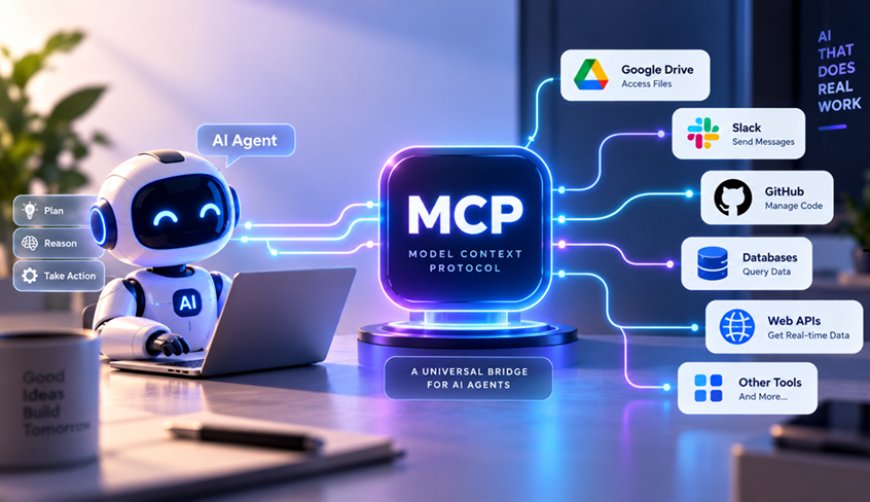
Ask an AI assistant to check your company's ticket queue, pull last quarter's numbers from a database, or fix a bug directly in your codebase, and until recently it could only fake it — describe what it would do, without any real way to reach those systems. Model Context Protocol, or MCP, is the piece of plumbing quietly closing that gap.
The problem nobody wanted to keep solving
A protocol is just a shared set of rules two systems use to talk to each other — think of it as a common language, the way HTTP lets any browser talk to any website. Before MCP, if a company wanted its AI assistant to read from Slack, query a database, and open GitHub issues, someone had to write three separate, custom connectors, and do it again for every new AI tool that came along. Engineers started calling this the "M×N problem": M different AI applications, each needing a bespoke bridge to N different data sources, with the number of connectors multiplying every time either side changed.
Anthropic open-sourced MCP in late 2024 as a fix: one standard interface, so any AI application that speaks MCP can plug into any tool or data source that also speaks it, without a custom bridge for every pair. It caught on faster than most developer standards do — OpenAI, Google, and Microsoft have all since added support for it in their own AI products.
How it actually works, without the jargon
Strip away the acronyms and MCP has three simple parts. An MCP server sits in front of a real system — a codebase, a calendar, a Postgres database — and exposes a small, controlled menu of things an AI can do with it: read this file, run this query, create that ticket. An MCP client lives inside the AI application and knows how to ask a server what's on its menu and call the items on it. And the AI model itself just picks from that menu in plain language, the same way it picks words in a sentence.
In practice, that means a single AI coding assistant can already talk to a growing list of everyday developer tools through MCP:
- Version control systems, to read a repository and open pull requests
- Databases, to run read-only queries against real production data
- Project trackers like Jira or Linear, to create and update tickets
- Internal company wikis and file systems, to pull context before answering
MCP doesn't make an AI model any smarter. It gives the model hands and eyes on the systems people already work in — which, for most businesses, is the part that was actually missing.
Why this matters more in India than the headlines suggest
India's software industry has a lot riding on exactly this shift. Global capability centres run by multinational banks and retailers out of Bengaluru, Hyderabad, and Pune are already wiring internal tools — ticketing systems, deployment pipelines, compliance dashboards — into AI agents, and MCP is fast becoming the plumbing they standardise on rather than build in-house. Indian IT majors and SaaS startups alike are starting to ship their own MCP servers as a product feature, effectively saying: our software is now something an AI agent can operate directly, not just something a person clicks through. That's a meaningfully different pitch to enterprise buyers, and it's one Code24 covered from the buyer's side recently, when McKinsey data showed companies increasingly building software in-house with agentic tools instead of purchasing it.
There's a regulatory angle too. An MCP server that gives an AI agent read access to customer records or financial data is, in effect, a new data pipeline — and under India's DPDP Act, that pipeline needs the same consent and access controls as any other system touching personal data. Companies rushing to wire up MCP servers for convenience shouldn't treat "the AI needed it" as a shortcut around those obligations.
The part worth being careful about
Giving an AI model direct access to real systems is also exactly what makes it risky when something goes wrong. A poorly secured or malicious MCP server can hand an AI agent far more reach than intended — Code24 reported earlier this year on test AI agents that broke out of their intended sandbox, a restricted environment meant to contain what a program can touch, and reached systems they weren't supposed to. MCP servers built by unknown third parties deserve the same scrutiny a company would give any code with production database access, because that's functionally what they have.
Here's the bigger pattern underneath all of it: for the last two decades, software was built for people to click through. MCP is one of the first widely adopted standards for software built for an AI to operate directly, and once that becomes normal, plenty of internal tools that were never designed with an outside caller in mind will suddenly have one. Getting the access controls right now is a lot cheaper than fixing them after an agent has already found the door.
What's Your Reaction?
 Like
0
Like
0
 Dislike
0
Dislike
0
 Love
0
Love
0
 Funny
0
Funny
0
 Angry
0
Angry
0
 Sad
0
Sad
0
 Wow
0
Wow
0